

Blog
What Is HubSpot? Complete Overview & Key Features


Table of Contents
- HubSpot Explained: What It Is and How It Compares to Local SEO
- HubSpot CRM and Local SEO: Understanding the Core Differences
- Deep Dive into HubSpot Features and SEOLocal Alternatives
- Practical Steps for Evaluating HubSpot and SEOLocal for Your Business
- Advanced Considerations: Multi-Location SEO and White-Label Solutions
- Common Questions About HubSpot and Local SEO
- Making the Right Choice for Your Local SEO Needs
HubSpot Explained: What It Is and How It Compares to Local SEO
what is hubspot? At its core, HubSpot is a comprehensive customer relationship management (CRM) platform that combines marketing automation, sales tools, and service software into one unified system. While powerful for inbound marketing campaigns and nurturing leads across broad markets, HubSpot’s CRM differs fundamentally from hyperlocal search optimization. Our AI-driven local SEO services target Google Business Profile visibility, citation consistency, and local keyword performance to drive fast results — often within the first 30 days. Where hubspot crm excels at managing customer journeys and email workflows, local SEO demands a different skill set focused on geo-specific ranking factors and community engagement.
HubSpot follows a traditional inbound methodology, building brand awareness through content marketing, social media, and lead scoring. Local SEO, by contrast, operates where purchase intent is highest — in Google’s local pack and map results. hubspot pricing is competitive for companies needing enterprise-grade marketing automation, but local visibility requires dedicated Google Business Profile optimization, review management, and localized content creation without any long-term commitment. Understanding this distinction helps businesses allocate resources effectively: HubSpot supports broad customer acquisition, while our AI-driven local SEO delivers neighborhood-level visibility with transparent reporting and no contract or commitment. For a detailed comparison of these approaches, refer to our local SEO services evaluation guide.
HubSpot CRM and Local SEO: Understanding the Core Differences
To understand what HubSpot CRM is and how it differs from a dedicated local SEO platform, let’s compare the two. Many businesses ask “what is HubSpot” when evaluating tools; HubSpot CRM is a customer relationship management platform built for sales and marketing automation, not local search optimization. In contrast, SEOLocal provides an AI-driven local SEO solution designed to improve local visibility, manage Google Business Profiles, and build local citations.
While HubSpot CRM excels at managing customer interactions and pipelines, it lacks the specialized tools needed for local search success. Its features focus on email marketing, deal tracking, and basic reporting, without built-in local SEO capabilities like citation building or review management. Our platform fills this gap with AI-powered content creation tailored to local keywords, a targeted link network, and white-label reporting. Unlike HubSpot’s tiered HubSpot pricing model requiring annual commitments, we offer no contract or commitment and a 30-day trial, making quality local SEO accessible. The following table highlights the core differences across key features.
| Feature | HubSpot CRM | SEOLocal Local SEO |
|---|---|---|
| Pricing model | Annual Contracts | No Contract / Monthly |
| Local SEO focus | General SEO | Hyperlocal/GBP focus |
| Content creation | Inbound Content | AI-Driven Local Content |
| Link building | None (Internal Only) | Vetted Link Network |
| Reporting | CRM/Sales Funnel | White-Label SEO Dashboard |
| Contract flexibility | Rigid Annual | Flexible/30-Day Trial |
These differences underscore why a general CRM like HubSpot cannot replace a dedicated local SEO tool. SEOLocal’s specialized features are built specifically for local businesses aiming to appear in map packs and localized searches. With our no-contract model and AI-driven local SEO, agencies and businesses can get Fast SEO Results! without long-term commitments.
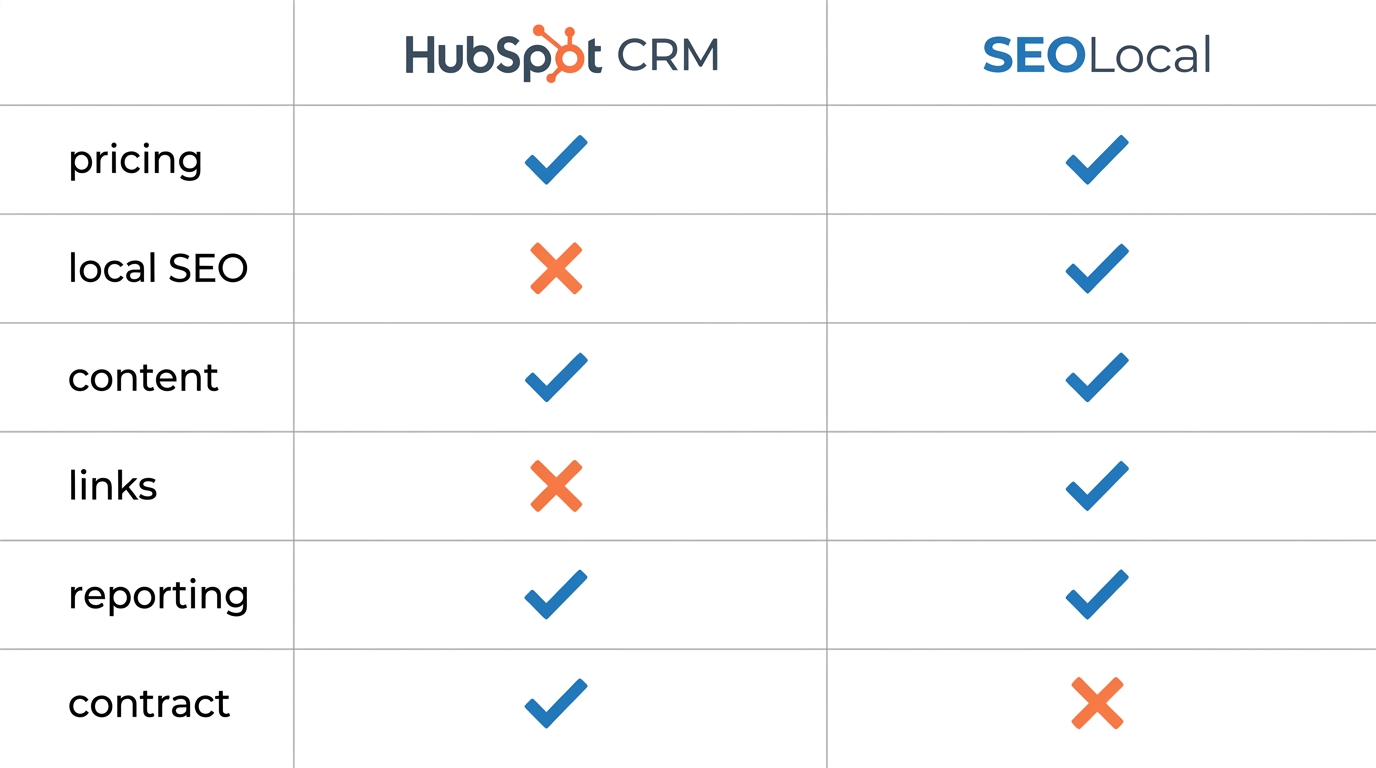
Visual comparison of HubSpot CRM and SEOLocal local SEO features.
With these differences clear, let’s explore how SEOLocal’s AI-driven local SEO delivers results that HubSpot CRM cannot. Our platform’s quality vs quantity approach ensures your local presence grows with targeted, authoritative strategies. (Results may vary; no guarantee of specific ranking improvements.)
Deep Dive into HubSpot Features and SEOLocal Alternatives
Having explored the foundational overview of HubSpot and SEOLocal, it’s now essential to examine the specific capabilities that differentiate these platforms for agencies and businesses focused on local search visibility. While understanding what is HubSpot illuminates its role as a broad inbound marketing suite, discerning the technical depth of its SEO tools in comparison to a specialized provider like SEOLocal will reveal where each platform delivers the most value.
Feature Comparison: HubSpot Marketing vs. SEOLocal Local SEO
A detailed feature analysis highlights significant differences in how each platform approaches search engine optimization. Staying current with search engine marketing industry news consistently shows the value of specialized tools over generalized suites for achieving deep local market penetration. The following comparison breaks down the core capabilities:
- SEO Tools: The HubSpot platform provides built-in SEO recommendations that integrate with its broader content management system, focusing on general on-page optimization and topic clusters. SEOLocal, however, is an AI-driven local SEO platform designed specifically for map-pack rankings, including advanced GBP optimization and localized content strategies.
- CRM Integration: A key component of HubSpot is its native, powerful CRM that ties marketing activities directly to sales pipelines. SEOLocal takes a different approach, integrating with external CRMs to support white-label reporting, allowing agencies to present local SEO data within their own client management systems using our tools.
- AI Content Generation: HubSpot’s AI assistant helps draft blog posts and marketing emails. SEOLocal’s AI content system is purpose-built for local visibility, generating editable long-form articles optimized for specific service areas, which is a core part of our quality vs quantity approach to content.
- Link Network: HubSpot does not provide a link-building network, as its focus is on owned content and analytics. SEOLocal provides automated link placement from a vetted, relevant partner network, a critical factor for local ranking growth that emphasizes quality over bulk volume.
- White-Label Options: HubSpot’s partner tiers allow some agency branding, but the underlying platform remains HubSpot. SEOLocal is built for reseller partnerships with fully white-label capabilities, enabling agencies to offer comprehensive local SEO services under their own brand without a hint of the source platform.
- Multi-Location Support: HubSpot can manage multi-location businesses but often requires complex, custom setups. SEOLocal is engineered for scalable local campaigns, making it simple to manage and report on dozens or hundreds of business locations from a single, unified dashboard.
This juxtaposition clearly shows that a general marketing platform and a specialized local SEO engine serve fundamentally different purposes for an agency’s tech stack. The distinction lies in the depth of local optimization features versus broad marketing automation.
Pricing and Contract Flexibility
A crucial consideration for any business is the financial and contractual commitment required. HubSpot’s structure includes a free starter tier that draws users in, but accessing its marketing automation and SEO features typically means a rapid escalation to paid plans, which can be costly and are governed by annual contracts. This model can present a significant barrier for small businesses or agencies testing new services.
Our pricing philosophy at SEOLocal is based on no contract or commitment, with subscription access starting at competitive per-keyword rates. This straightforward model is reinforced by a 30 day trial period, allowing businesses to see the impact of our local SEO campaigns without a long-term financial lock-in before making a decision. This demonstrates our confidence in the platform’s ability to drive value without relying on rigid, long-term agreements to retain clients. This flexible approach directly addresses the uncertainty businesses face when evaluating new marketing vendors.
Integration and Data Migration Considerations
When switching platforms, the technical aspects of integration and data transfer are paramount. HubSpot functions best as a central nervous system for a company’s marketing, syncing seamlessly with its own CRM and a wide array of third-party tools through a robust app marketplace. Migrating away from it, however, involves exporting contacts, content, and analytics data, a process that can be technically demanding.
Transitioning your local SEO efforts to SEOLocal is a more focused process. We provide extensive knowledge base resources and direct support to facilitate a smooth onboarding experience. Our platform is designed to integrate into your existing workflow, whether that involves pulling data into your own analytics dashboards via our reporting API or managing tasks within your project management software, ensuring that adopting an AI-driven local SEO strategy enhances rather than disrupts your agency’s existing operations.
Practical Steps for Evaluating HubSpot and SEOLocal for Your Business
Now that we’ve introduced both platforms, let’s walk through practical steps to evaluate them for your business. A structured comparison helps you identify which solution aligns with your operational goals, whether you prioritize comprehensive CRM capabilities or specialized local SEO performance.
Assessing Your Business Needs
Before comparing features, start by listing your primary business requirements. Understanding what is HubSpot helps clarify whether a full inbound marketing suite matches your objectives. HubSpot CRM excels at managing customer relationships, sales pipelines, and content automation across channels. However, if your focus is local visibility, multi-location management, and AI-driven local SEO, SEOLocal offers a specialized alternative.
Small businesses evaluating HubSpot pricing should weigh the platform’s broad functionality against their actual needs. For companies primarily seeking local search dominance, SEOLocal’s targeted approach delivers relevant linking partnerships and Google Business Profile optimization without the complexity of a full CRM. Consider whether your team needs comprehensive marketing automation or specialized local ranking improvements.
Trial and Onboarding Comparison
The trial experience reveals much about each platform’s commitment to user success. HubSpot offers a free tier with limited features, allowing businesses to explore basic CRM functionality before upgrading. However, accessing advanced marketing tools requires a paid subscription. HubSpot provides extensive documentation and a community forum for self-guided onboarding.
In contrast, our AI-driven local SEO platform provides a full-featured 30-day trial with no contract or commitment. We believe in demonstrating value through quality vs quantity link building and transparent reporting from day one. Our onboarding includes personalized support alongside a comprehensive knowledge base, ensuring you understand how our automated processes improve local rankings without long-term obligations.
Measuring ROI: Reporting and Analytics
Evaluating return on investment requires robust reporting tools. HubSpot’s comprehensive marketing dashboard tracks website traffic, email performance, and lead generation metrics. While its basic keyword tracking provides general visibility, agencies needing client-facing reports may find limitations.
SEOLocal specializes in transparency for local SEO campaigns. We offer a white label local SEO dashboard performance tracking system that allows agencies to monitor rankings and client metrics under their own brand. This capability proves essential for resellers and multi-location businesses requiring professional, branded reporting without developing proprietary tools.
The following table compares key reporting features between the two platforms:
| Feature | HubSpot | SEOLocal |
|---|---|---|
| Dashboard | Multi-channel Marketing | Hyperlocal Visibility |
| Ranking reports | General Keyword | Geo-specific/Map Pack |
| White-label reporting | Requires CMS Enterprise | Native White-Label |
| Integration with other tools | Extensive Ecosystem | API & Marketing Tools |
SEOLocal’s reporting capabilities emphasize actionable local insights rather than general marketing metrics. Our white-label functionality, detailed in our internal knowledge base, empowers agencies to resell SEO services while maintaining consistent brand identity. HubSpot’s strength lies in its broad integration ecosystem, making it suitable for businesses managing complex, multi-channel marketing strategies. No guarantee of specific ranking improvements; results may vary.
With these evaluation criteria in mind, let’s summarize which platform is best for different business scenarios.
Advanced Considerations: Multi-Location SEO and White-Label Solutions
For businesses managing multiple locations or needing white-label solutions, the choice between HubSpot and SEOLocal becomes more nuanced. But first, what is HubSpot? HubSpot is a robust CRM and marketing platform, but its broad focus differs from our specialized local SEO tools. When evaluating multi-location and partner capabilities, the platform you choose matters. The following table breaks down key features that agencies and multi-location brands need.
| Feature | HubSpot | SEOLocal |
|---|---|---|
| Multi-location management | Custom CMS Setup | Automated GBP/Bulk |
| White-label options | Partial Branding | Full White-Label |
| API access | CRM & Marketing | Real-time Rankings |
| Partner program | Software Reselling | Revenue-Share/W-L |
Effective multi-location management demands more than just separate pages. HubSpot’s CMS Hub can create location-specific pages, but it lacks dedicated local search integration. Our platform builds dedicated local landing pages with automated Google Business Profile sync and bulk editing, giving agencies streamlined control over dozens of locations.
When it comes to white-label options, HubSpot’s ecosystem offers no native white-label reporting. Agencies using HubSpot must build their own client dashboards or rely on third-party integrations. In contrast, SEOLocal provides a fully branded experience — from dashboards to downloadable reports — so your clients see your agency’s identity, not ours.
API access also highlights the different scopes of the two platforms. HubSpot’s extensive API supports deep CRM and marketing automation, which can be powerful for inbound strategies. However, for local SEO performance data, our API delivers real-time rankings, review summaries, and multi-location reporting, as referenced in our white-label FAQ.
Finally, the partner program differences are key for agencies. HubSpot’s Solutions Partner Program is built around reselling software and delivering marketing services. Our partnership model goes further by enabling white-label reselling with revenue-sharing and transparent performance tracking — making us a true extension of your team.
In summary, HubSpot excels as an all-in-one CRM, but SEOLocal’s dedicated multi-location management, white-label reporting, and agency-focused partner program make it the stronger choice for local SEO agencies and multi-location businesses.
Common Questions About HubSpot and Local SEO
What is HubSpot?
HubSpot is a customer relationship management platform that helps businesses organize contacts, track interactions, and automate marketing tasks. The hubspot crm serves as a centralized system for managing leads and monitoring where prospects come from — including local search channels. We frequently hear from small businesses exploring how the HubSpot platform fits into their broader local SEO strategy.
How does HubSpot support local SEO efforts?
For local businesses, HubSpot’s tools can function as a lead-tracking layer that captures inquiries from Google Business Profile, local landing pages, and directory listings. The platform logs the source of each contact, letting you attribute conversions back to specific local keywords and campaigns. While HubSpot itself does not optimize your on-page signals or build local citations, it gives you the visibility to understand which local SEO activities drive real calls and form fills.
How much does HubSpot cost for local SEO purposes?
When businesses ask about hubspot pricing, they are usually evaluating whether the CRM fits their budget alongside their local SEO investment. HubSpot offers a free CRM tier and paid plans that scale with your needs. At SEOLocal, we keep our own pricing competitive — our AI-driven local SEO platform starts at simple per-keyword rates with no long-term commitment, so you can pair tools without locking into rigid contracts.
Is HubSpot worth it for small business local SEO?
With proper setup, HubSpot works well for small businesses that want to track local lead quality rather than just rankings. We believe the strongest approach combines a capable CRM like HubSpot with an AI-driven local SEO engine that handles on-page optimization, content creation, and link building automatically. Fast SEO Results! are possible when you align the right CRM tracking with consistent local campaign execution — though individual outcomes vary and no ranking guarantees can be made.
Making the Right Choice for Your Local SEO Needs
Now that you understand the landscape, selecting the right partner comes down to focus and flexibility. While you may be researching what is HubSpot for its broad CRM capabilities, a specialized AI-driven local SEO platform delivers targeted visibility for your locations. Platforms such as HubSpot CRM offer extensive marketing suites, but for hyperlocal results, automation and quality link building matter more.
HubSpot pricing can escalate quickly with add-ons and tiered plans. Our approach is different: a 30 day trial with no contract or commitment lets you evaluate AI-driven local SEO with real-time reporting and Google Business Profile optimization, often seeing results within 30 days. This reflects a quality vs quantity mindset—focused execution over platform bloat.
When weighing your options, consider speed, transparency, and the freedom to walk away anytime. Fast SEO Results! start with a partner built entirely for local search.
Resources
- Compare White-Label Local SEO Reporting Tools for 2025
- Find the Best White-Label Local SEO Dashboard for Performance
- Guide to Evaluating Local SEO Services for Small Businesses
- Build Quality Links for Local SEO with Free Trial
- Discover Top Marketing Agencies in Huntsville, Alabama
- Access Free Local SEO Trial and Expert Resources
- Achieve Affordable Local SEO Services in Deland
- Stay Informed with Search Engine Marketing Industry News