

Blog
Conversational Local Search Intent Signals: Complete Guide for 2026


Table of Contents
- The Evolution of Local Search in the Age of AI
- Decoding Conversational Local Search Intent Signals
- How AI Engines Interpret Natural Language Queries for Local Results
- Key Signals That Trigger AI-Driven Local Recommendations
- Generative Engine Optimization Strategies for Local Businesses
- Leveraging Structured Data for Generative Local Search Visibility
- Future-Proofing Your Local SEO for Generative AI
The Evolution of Local Search in the Age of AI
conversational local search intent signals will help us understand the future of local search, powered by AI. Not too long ago, local searches began with printed directories. Search Engines then added maps to their interfaces. Devices then added location-based services to make local searches easier. With the aid of AI, local searches will now evolve to answer full-sentence searches. More and more people will be asking questions like, “where can I get the best pizza in Miami with outdoor seating?” with searches evolving beyond mere keywords. Targeted keywords, once the cornerstone of SEO, will now evolve into targeted questions. Local businesses have to take these conversational signals to best reflect their position in local searches. Through AI-powered local SEO platforms, we can achieve fast SEO results by harnessing these patterns. The challenge remains: how can we effectively interpret and act on these conversational intent signals to maintain a competitive advantage?
Decoding Conversational Local Search Intent Signals
Instead of typing terse, disconnected keywords such as “pizza Miami,” users now pose full, natural-language questions: “where can I get a thin-crust pizza delivered right now in Miami?” These conversational search patterns carry rich intent signals—cues about proximity, urgency, and specificity—that plainly reveal what the searcher truly wants. Decoding these signals is no longer optional for local businesses; it is the foundation of modern visibility.
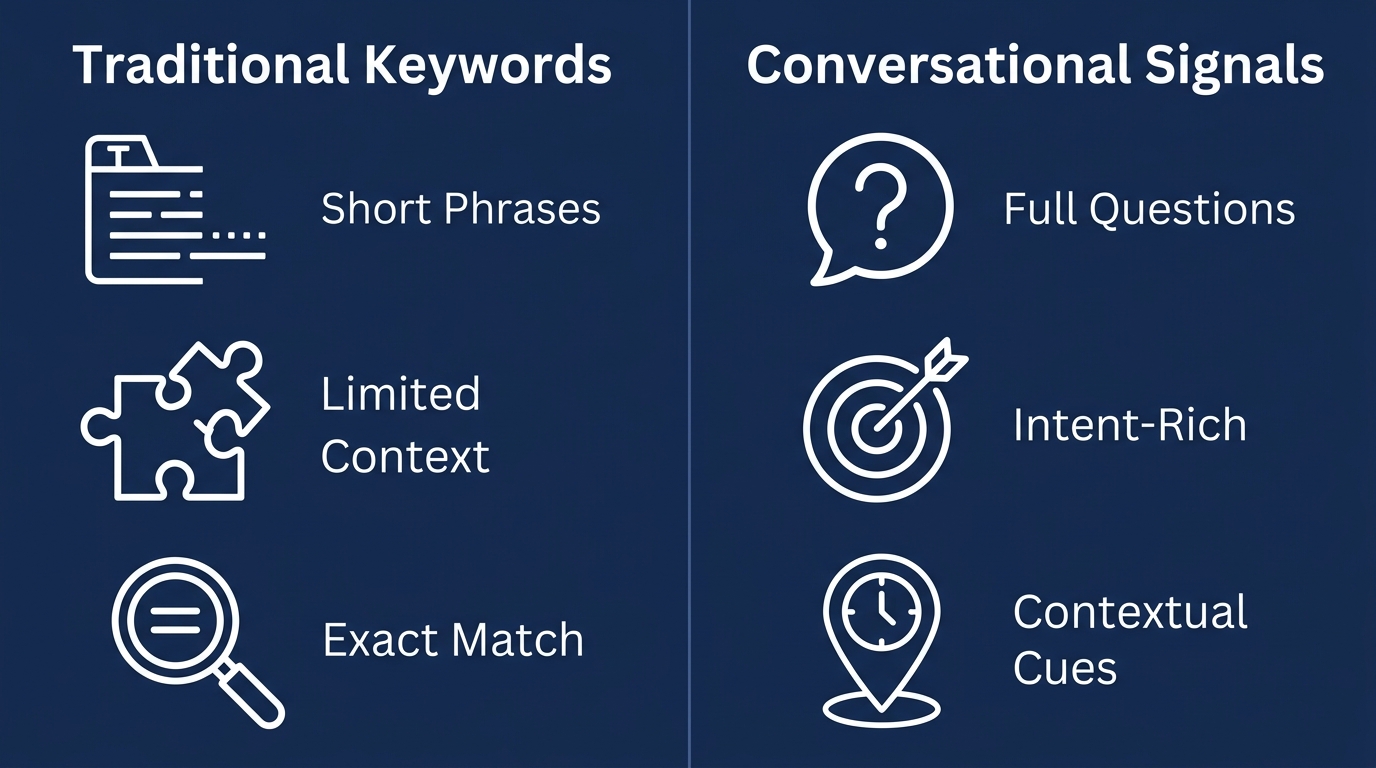
The example search for “Miami pizza” leaves a lot of room for interpretation. It may be a tourist planning ahead or a resident considering different places to eat. The search for “delivery right now” obviously indicates a customer who is ready to make a purchase.
Proximity cues—“near me,” “in Brickell,” “downtown within walking distance”—anchor the search to a specific geography, telling us the person is ready to visit or receive service in that area. Time-sensitivity signals like “open now,” “tonight,” or “before 9 p.m.” indicate an immediate need and often a strong likelihood of conversion. Service specificity adds precision: a query such as “emergency plumber same-day in Coral Gables” or “dog groomer open on Sunday near South Beach” narrows the expectation to an exact, often urgent requirement.
A question that starts with “where can I buy…” signals a transactional need, while “what’s the best…” suggests informational research, and “show me the address of…” is navigational. Modifiers like “affordable,” “top-rated,” or “I’m on a deadline” introduce sentiment and urgency layers that help us gauge the searcher’s decision stage.
These natural-language signals shape how AI-powered search interfaces understand intent. For businesses, aligning website and profile content with the way real people ask for services is central to generative engine optimization for local business. When we mirror conversational phrasing—using location-rich descriptions, direct answers to common questions, and context that matches urgency—we make it easier for AI-generated answer boxes and local summaries to surface our information precisely when a nearby customer signals they are ready to take action. Understanding these intent signals is the crucial groundwork that must be laid before we can examine how AI systems technically interpret and rank that local information.
How AI Engines Interpret Natural Language Queries for Local Results
Once a conversational query’s intent is decoded, AI engines must translate those natural language cues into actionable queries that deliver location-specific results. This process relies on a combination of natural language processing (NLP), entity extraction, and structured data interpretation.
When a user asks, “find a plumber in Miami open now,” the engine first applies NLP techniques such as tokenization, which splits the sentence into individual words, and part-of-speech tagging, which labels each token as a noun, verb, or preposition. Dependency parsing then identifies grammatical relationships—for example, linking “in Miami” to the location and “open now” to a temporal condition. From this parsed query, the AI extracts entities: the service type (“plumber”), the geographic context (“Miami”), and an urgency signal (“open now”). These components let the model understand that the user wants a specific kind of local business, not just any plumber anywhere.
Ultimately, the type of structured data available on the web can impact the level of confidence AI has when determining if a local business is relevant to a user’s query; for example, markup like Schema.org LocalBusiness provides machine-readable fields (business name, address, phone number, opening hours, and service area) that crawlers can ingest to verify location and opening hours. When a crawler encounters that markup, it can ingest accurate location and service details without relying solely on page text, which helps the AI quickly verify that a plumber in Miami is indeed local, open at the current time, and relevant to the query.
Extracted entities are mapped to a local knowledge graph. The service entity, “plumber,” aligns to business categories, “Miami” associates to geo-coordinates, and “open now” becomes a trigger to check business hours. AI engines combine these signals and manage ranking based on relevance, distance, and prominence. They use implicit local signals. For example, “near me” uses the location of the device, and “best in Miami” means the AI needs to give recommendations based on the best, or highest reviewed, providers in Miami. However, outcomes can vary based on several factors, and the rankings are not guaranteed.
Analyzing how AI understands these types of queries enables recognition of the signals that drive local recommendations. With this knowledge, our platform helps businesses leverage these insights without requiring a long-term contract or commitment.
Key Signals That Trigger AI-Driven Local Recommendations
When a user speaks naturally, AI search engines pick up on the intent and create conversational cues. These serve as triggers for key signals that dictate which local businesses are shown in recommendations. We go over the most important signals here.
Proximity acts as a primary filter. Even without explicit “near me” phrasing, device GPS, IP address, and stored location preferences tell the AI where the user is. A search in Miami for “plumber” will automatically surface providers based on their distance from the searcher’s coordinates, often overriding broader relevance for ultra-local needs.
One of the largest factors of relevance is alignment of the business category and keyword search. For example, a query for “emergency dental” will often result in the AI cross-referencing businesses categorized as “emergency dentists,” and those with matching content themes will rise. We find that accurate business categorization and inclusion of relevant keywords help determine queries that result in a recommendation.
Prominence builds on the factors of reputation and visibility. For example, if a business has good reviews, consistent business information across the web, and a complete Google Business Profile, the business is likely to show up in local recommendations.
Real-time modification is enabled by conversational and contextual cues. Each phrase is weighted differently. Some examples are “open now,” “best,” and “affordable.” The AI is constantly tracking user preferences and combines that with additional prompts to create and adjust results. If the prompt is “family-friendly restaurants open late,” the AI will make a determination about current business hours and preferences. Local results are created based on the prompts entered by the user.
User intent differentiation separates informational questions from purchase-ready searches. A query like “how to fix a leaky faucet” triggers instructional content, while “plumber near me” signals transactional intent and pulls up local service providers. Recognizing these user intent signals helps tailor content and listings to the right buyer stage.
Understanding the various prompts and signals creates an opportunity for an optimization and strategy refinement focused on the needs of the user. A 30 day free trial of a service allows companies to begin aligning their business and offering with these signals and prompts on the first day.
Generative Engine Optimization Strategies for Local Businesses
Once local businesses understand the triggers for AI-generated recommendations, we help them enact strategies that appear in prominence in generative search. Our approach to local SEO leverages AI to create content that is aligned to local, conversational queries.
Optimize for Conversational Long-Tail Queries
We embed natural language question-and-answer formats within local pages. For example, answering “What time does the best Italian restaurant in Miami open?” directly on the restaurant’s website helps capture queries that voice assistants and AI search features commonly process. This approach ensures that the content mirrors how people actually ask about local services, making it more likely to appear in generative results.
Build Local Topic Clusters Around Core Services
We structure content into clusters that signal topical authority. A plumber, for instance, can create pillar pages for “plumbing services in Miami” and link them to detailed subpages on “emergency plumbing in Miami,” “water heater repair in Miami,” and “drain cleaning in Miami.” Internal linking within these clusters reinforces the relationships between topics, signaling to generative engines that the site comprehensively covers related local queries.
Maintain an Active and Complete Google Business Profile
Regular updates, Q&A responses, and accurate service attributes on a Google Business Profile feed verified information to AI-driven knowledge sources. We recommend posting weekly, answering questions promptly, and keeping categories and hours current. This consistency makes business data more trustworthy for generative summaries.
Preserve Consistent NAP Citations
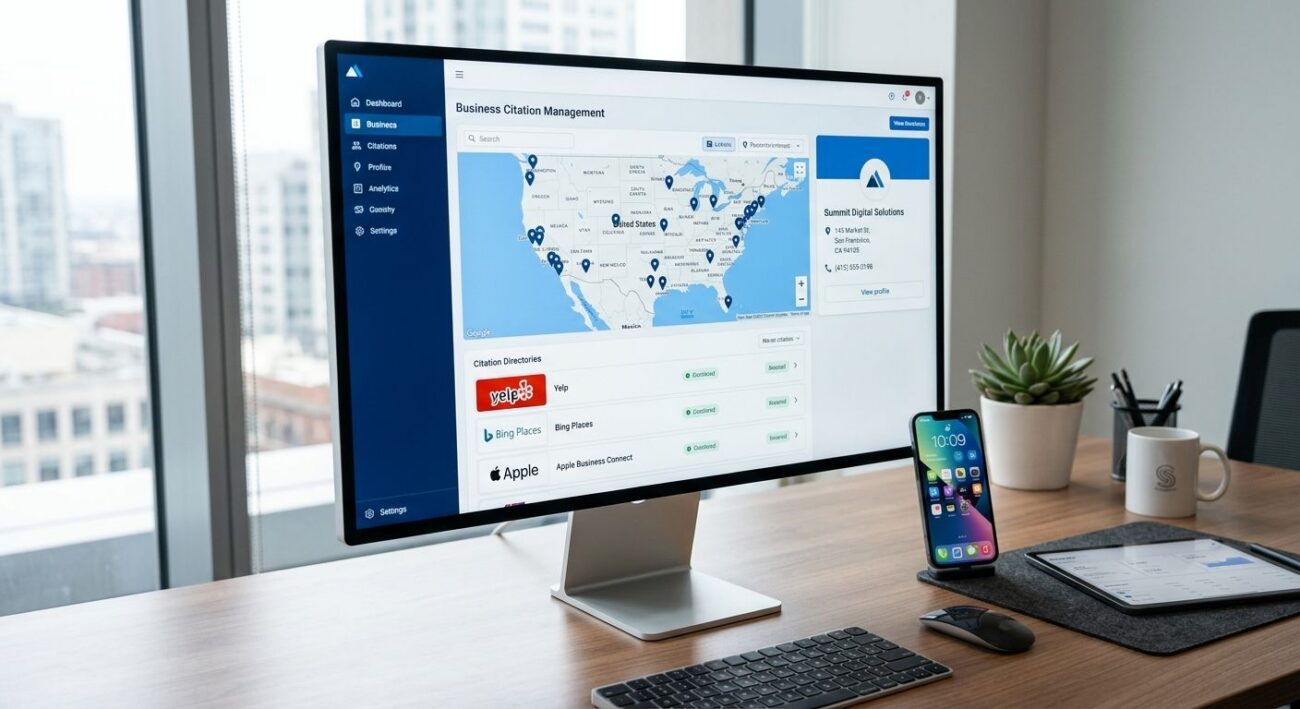
Ensuring that the name, address, and phone number are identical across all authoritative local directories—such as Yelp, Bing Places, and industry-specific listings—strengthens local relevance signals. We guide businesses in auditing their citations to eliminate discrepancies that could confuse both traditional and generative search engines.
Create E-E-A-T Content That Demonstrates Real Local Results
We help businesses develop content that builds experience, expertise, authority, and trust. This includes detailed author bios of local team members, genuine client testimonials with specific outcomes, and case studies that highlight successful projects in the community. Such content provides the depth that generative systems value when selecting authoritative local answers.
Used in conjunction with structured data markup that explicitly informs generative systems about local business details, these tactics work even more effectively.
Leveraging Structured Data for Generative Local Search Visibility
Underpinning every effective generative optimization strategy is the technical architecture that AI models rely on: structured data. For local businesses serving Miami and beyond, schema markup acts as a machine-readable blueprint that clarifies who you are, where you operate, and what you offer – enabling search engines to surface accurate information in conversational, AI-driven results.
Key schema types for generative visibility
- LocalBusiness – The foundational type. It communicates essential NAP (name, address, phone), service area, and operating hours.
- FAQ – Marks up question-and-answer pairs. When properly implemented, FAQ markup can supply direct answers to voice-based queries and appear within generative snapshots.
- Product – For e-commerce sites, it surfaces pricing, availability, and review data in a format.
- Review – Aggregate ratings and individual reviews, marked up with the Review schema, help models gauge trustworthiness.
- Event – Highlights time-sensitive happenings.
- Article – Supports content-driven queries by explicitly stating headline, author, and publication date, improving topical attribution.
Unlike traditional rich snippets that merely produce eye-catching visual badges, generative AI citation draws from the same structured signals to determine what information appears inside a conversational answer. A LocalBusiness schema with complete markup may not guarantee a featured snippet, but it substantially raises the odds that an LLM will select your validated entity over an unmarked competitor when synthesizing answers about local services in South Florida.
Actionable implementation and auditing
- Implement JSON-LD (JavaScript Object Notation for Linked Data).
- Ensure NAP consistency across all schema occurrences and the visible page; mismatches can confuse AI parsers.
- Include
areaServedto define your service geography precisely, whether a city like Miami or an entire region. - Mark up
openingHoursSpecificationso models know when you are reachable. - Run your pages through the Schema Markup Validator or Google’s Rich Results Test to catch missing required properties, incomplete review markup, or business-type specifications that are too generic.
While structured data provides the syntactic clarity AI needs today, maintaining visibility requires a forward-looking approach to the shifting landscape of local SEO. The schema groundwork you lay now becomes the bedrock for future innovations in how generative systems understand and recommend local businesses across the US and internationally.
Future-Proofing Your Local SEO for Generative AI
Future-proofing your local SEO means doubling down on conversational local search intent signals and continuously adapting to generative AI’s evolving demands. Building on that foundation, we recommend a proactive, multi-layered approach.
To start, regularly audit and update your business listings, structured data, and local citations to ensure AI-generated answers rely on accurate information. Next, develop content that is conversational and question-based. This not only aligns with the search intent of AI, but improves your content for voice search and featured snippets as well.
While the local SEO signals our platform automates continue to be essential, remaining informed on new Generative AI developments is equally important. While no single tactic guarantees results and outcomes may vary, we believe that structure and the combination of content and reputation management are critical for thriving in the search and local SEO space. By treating local SEO as a disciplined and continuous process, you can more effectively adapt to changes.
Get AI-Driven Local SEO Support
Understanding conversational local search intent signals is a crucial step toward improving your business’s visibility in AI-driven search results. Now that you’ve learned how AI engines interpret natural language queries and the key signals that trigger local recommendations, it’s time to put that knowledge into action. SEOLocal’s AI-powered platform automates the optimization of these very signals, from structured data to Google Business Profile management. With a 30-day free trial and no long-term commitment, you can test these strategies risk-free. Our platform continuously adapts to generative engine optimization changes, helping your business stay ahead of the curve. Start aligning your local presence with how AI actually reads and ranks local intent today.