


Blog
Automated Citation Building Services: Fast Professional Setup

Table of Contents
- Understanding Automated Citation Building Services and Local SEO
- Key Benefits of Automated Citation Building Services for Local Businesses
- How SEPLQ’s Automated Citation Service Works
- Best Practices for Automated Citation Building in the US
- Ready to Build Consistent Local Citations?
Introduction to Automated Citation Building Services in the US
For multi-location businesses across the United States, keeping name, address, and phone number (NAP) data consistent across the web feels like a never-ending game of whack-a-mole. A single outdated suite number on a directory site can confuse potential customers and weaken the trust signals search engines rely on. This is precisely why citations remain one of the foundational off-page local SEO tactics available today. According to Moz’s Beginner’s Guide to Local SEO, accurate and consistent directory listings function as a core trust factor, helping search engines verify that a business is legitimate and relevant to local queries. For multi-location operators, that foundational role often translates into fewer customer confusion incidents and measurably fewer missed leads when listings remain aligned across platforms.
SEOLocal addresses this challenge head-on with our AI-driven local SEO platform, which delivers Fast SEO Results! by automating citation distribution across a vetted network of directories. Our dashboard integrates with Google Business Profile and common ticketing systems so teams can monitor publication status, assign follow-ups, and reconcile exceptions without switching tools. Our technology works by programmatically pushing consistent NAP data to high-quality platforms, a process that, for many campaigns, yields visible movement in local pack performance often within 30 days, though individual outcomes vary and no guarantee of specific ranking improvements can be made; results may vary. Because we believe in proving value before any long-term commitment, we offer a straightforward 30 day trial with no contract or commitment required. You simply subscribe at a predictable monthly fee and start seeing your business information propagate across the web without the manual grind.
Why Citations Still Matter for Local SEO
Despite algorithm updates that shift weighting among hundreds of signals, citations have not lost their relevance. Google’s own local search ranking system aggregates business information from multiple sources across the web, cross-referencing what it finds on directories, social platforms, and industry-specific sites against your Google Business Profile. When these signals align, your business gains the consistency and prominence needed to compete in the local pack. BrightLocal’s industry research supports this, showing that citation signal strength correlates with local pack movement, particularly when businesses target competitive metropolitan areas like Miami, FL.
The key is understanding that modern automated citation building services in the United States are not about flooding the web with thousands of identical entries. Our approach at SEOLocal follows a quality vs quantity philosophy: a smaller set of authoritative, contextually relevant directories carries far more weight than a massive footprint on low-quality or unrelated sites. This principle helps you avoid the pitfalls of link schemes while maximizing the impact of each new citation that goes live.
What the Article Covers
This article walks you through what citation building automation actually does, how to apply it to your business, and the best practices that separate effective campaigns from wasted effort. We’ll also clarify where complementary work fits in: businesses often pair automated citation building with semrush web design services to fix on-site technical issues that also affect local visibility.
What Are Automated Citation Building Services and Why They Matter?
At its most basic level, a citation is any online mention of your business’s NAP data. That mention can appear on a general directory like Yelp, an industry-specific platform like Healthgrades, or a local Chamber of Commerce website. Manual directory submissions require a human being to log into each site individually, type in the exact same information, verify it, and repeat the process for every location. It’s painstaking, time-consuming, and highly susceptible to typos.
Automated citation building services change the equation entirely. Instead of logging into dozens or hundreds of sites one by one, you supply your verified NAP data once to a central platform. SEOLocal’s system then uses AI-driven distribution to push that consistent information across a curated network of directories, data aggregators, and mapping platforms. The service isn’t about generating random mentions; it’s about ensuring the same precise business details appear everywhere they matter, so that search engines and customers encounter a unified, trustworthy profile.
To make the practical benefits clearer, consider how automated citation building services in the US reduce operational friction for teams that manage dozens or hundreds of locations. Instead of routing multiple spreadsheets and ticketing requests through an operations queue, your centralized platform normalizes data, applies consistent field-level rules (for suite numbers, abbreviations, and phone formatting), and logs each publication event so you can audit where listings went live and when. The platform enforces normalization rules for suite numbers, abbreviations, and phone formats while also prioritizing high-value endpoints over low-quality pages. Because the platform enforces standardized NAP formatting and retests live entries periodically, the risk of divergent entries due to human error falls sharply. It also flags probable duplicates, suggests suppression or merge actions, and reduces the manual reconciliation burden on operations teams. That audit trail also helps with downstream processes such as review solicitation, duplicate suppression, and aggregator corrections.
From a measurement perspective, automated distribution provides clearer KPIs than manual work. You can track successful publishes, rejection rates, and time-to-live for each platform, which helps prioritize follow-up actions and justify spend to stakeholders. Reporting exports make it simple to share progress with stakeholders and tie activity to local marketing initiatives. Integration with Google Business Profile and major aggregators means changes you make in a single source of truth propagate faster through the ecosystem than isolated manual edits. For multi-location brands, this reduces the number of ad hoc fixes and brings predictable maintenance cadence to local listings operations.
Quality controls built into reputable platforms mitigate many of the classic citation pitfalls. Curated directory lists, human review checkpoints, and API-level relationships with primary aggregators help ensure that citations are placed where they matter most rather than on low-value pages. This "quality vs quantity" stance also simplifies cleanup: when a problematic listing is found, a centralized remediation workflow lets you fix or suppress the record across multiple endpoints without re-entering data site by site. In practice, that means fewer duplicate records, fewer conflicting addresses, and a faster path to coherent entity resolution across major mapping services.
Operationally, the time savings scale nonlinearly as you add locations. A single local manager can oversee hundreds of listings because the platform handles variance and automates routine checks; human time shifts from repetitive entry to exception handling and strategy. That shift not only lowers labor burden but also improves data governance and accountability: audit logs, role-based access controls, and versioning make it clear who changed what and when. Role-based permissions and clear audit trails let retail managers request changes while corporate admins review and publish, keeping governance tight without adding latency. For companies with seasonal or rapid store rollouts, the ability to onboard new locations quickly while preserving NAP integrity can materially reduce time-to-market for promotions and listing-dependent services.
Finally, pairing citation automation with targeted on-site fixes and content harmonization compounds the benefit. Resolving technical issues that impede crawlability, consolidating microformats, and aligning landing-page NAP with directory entries reduces friction for search engines and users alike. That is why many teams pair citation automation with routine site audits and structured content updates to maximize the visibility gains from each citation placed.
Metrics-driven teams should insist on clear reporting: incremental visibility changes, listing correction rates, and resolved duplicates. These indicators let you reallocate effort toward customer-facing work like review response and localized promotions. Client data is not sold or rented (per Privacy Policy); subscriptions have a minimum three-month term; refunds only by mutual agreement; Florida law governs.
Defining Automated Citations
To get the terminology right: a citation is a structured directory listing that includes at least your business name, address, and phone number. An unlinked mention differs from a citation because it’s a textual reference to your brand, perhaps in a blog post or a news article, that may or may not include NAP and often lacks a hyperlink. A manual directory submission is the human-driven process of claiming or creating a free listing on a single website. Automated citation building consolidates all of this into a single workflow: you provide accurate data once, and the platform distributes it at scale while maintaining NAP integrity across every endpoint.
When you’re evaluating automated citation building services for multi-location businesses in Miami, the distinction between citation types matters. A consistent NAP on authoritative platforms like the local Chamber of Commerce directory sends a stronger relevancy signal than a mention on an unrelated blog, and automated distribution ensures that consistency is maintained without the errors that creep into manual entry.
Manual vs. Automated Submission
Deciding between doing it yourself and letting software handle the heavy lifting often comes down to time, accuracy, and growth potential. The table below lays out the key differences across the metrics that matter most to business owners.
| Approach | Cost | Time | Consistency | Scalability |
|---|---|---|---|---|
| High labor cost | Predictable monthly fee | |||
| Hours per site | Minutes for multiple sites | |||
| Prone to errors | Highly consistent NAP | |||
| Hard to scale | Easily scales across locations |
As the table illustrates, the automated route wins on speed, consistency, and scale at a predictable cost.
The Role of Citations in Local Search Rankings
Per Google Business Profile Help, Google aggregates business information from multiple sources across the web, and keeping your name, address, and phone number consistent helps both customers and the accuracy of search results. When Google finds the same NAP data on your website, your Google Business Profile, and a dozen trusted directories, confidence in your business’s legitimacy increases. That confidence translates directly into improved local pack visibility, which is the strip of three business listings that appears at the top of many local search results.
BrightLocal’s citation research reinforces this connection: businesses that maintain accurate and consistent citations tend to perform better in local pack rankings compared to those with missing or conflicting NAP data. The mechanism is straightforward: search engines see consistent signals as proof that a business is established and operational, while conflicting data raises doubts that can suppress visibility. For a Miami-based restaurant, a matching NAP on Yelp, TripAdvisor, and the Greater Miami Chamber of Commerce directory tells Google that the establishment is real, relevant to local diners, and worthy of being shown to searchers.
Signals Search Engines Look For
Whitespark’s local search guidance breaks down the primary signals that search engines evaluate when assessing local business information. Understanding these signals helps you see why high-quality automated citations deliver value beyond just “more listings.”
- Relevance: How well your business matches the searcher’s intent. A family law firm with citations on legal directories like Avvo sends a stronger relevance signal to Google than the same firm listed only on general platforms.
- Prominence: How well-known and credible your business appears. Prominence is built through a combination of review volume, directory presence on authoritative sites, and backlinks. Consistent citations across respected platforms elevate your perceived prominence.
- Consistency: Whether your NAP data matches everywhere it appears. Even minor discrepancies, such as “Suite 100” versus “#100,” can fragment your entity identity and dilute ranking power.
Take a concrete Miami, FL example: a Cuban restaurant with a perfectly matching NAP on its Google Business Profile, Yelp, TripAdvisor, and the Greater Miami Chamber of Commerce directory sends unified signals across all three dimensions. The restaurant is relevant to “Cuban food Miami,” prominent through its presence on trusted dining guides, and consistent across every citation. That combination makes it far more likely to surface in the local pack than a competitor whose address is listed differently on each platform.
Myths vs. Facts
- Myth: Citations are dead in the age of AI-driven search. Fact: Citations remain a foundational off-page signal. While their relative weight shifts over time, search engines continue to cross-reference directory data to verify business legitimacy, and businesses with strong citation profiles consistently outperform those without.
- Myth: More citations always produce higher rankings. Fact: The quality vs quantity principle governs citation impact. A handful of authoritative, industry-relevant directories will move the needle far more than hundreds of low-quality or unrelated listings.
- Myth: Automated citations are inherently spammy. Fact: Automation becomes spammy only when it distributes to untrusted or irrelevant sites; when trusted data sources feed the automation, the result strengthens your local presence.
Now that we’ve covered what automated citations are and why they matter, let’s walk through the specific benefits you can expect when you implement citation building automation as part of your local SEO strategy.
Understanding Automated Citation Building Services and Local SEO
A key component of local SEO is ensuring your business information remains consistent across the web — this is where automated citation building services come in. When you invest in these services, you gain a systematic method for distributing your accurate business name, address, and phone number (NAP) across numerous online directories and platforms, typically powered by software or a dedicated service platform. For businesses operating in multiple markets, from locations in Miami to international territories, maintaining this consistency helps search engines and consumers verify your location data, supporting your potential visibility in local pack and map results without guaranteeing specific positions.
Citations play a foundational role in how search engines assess local relevance. Our AI-driven local SEO approach treats citation building services not as a stand-alone tactic, but as one integrated layer of a broader strategy. By ensuring your NAP details are consistent across the web, you build the foundational trust signals that complement other efforts like content creation and GBP optimization. While we don’t guarantee rankings, we’ve designed our platform to pursue Fast SEO Results! by combining citation consistency with on-page optimizations.
Automated Citations vs. Manual Link Building: Key Differences
Understanding the difference between citations and links sets the stage for building a balanced local SEO approach. The following quick comparison using rows and columns highlights the core distinctions in purpose, effort, and risk between automated citation building services and manual outreach.
| Aspect | Automated Citation Building | Manual Link Building |
|---|---|---|
| Purpose | Consistent NAP and local signals | Authority and relevance |
| Effort | Low, automated | High, manual outreach |
| Cost | Predictable monthly fee | Variable, higher |
| Risk | Lower risk, if using quality directories | Higher risk if spammy links are used |
Citations build consistency; links build authority. This table illustrates why we emphasize a quality vs quantity philosophy. Automated citation tools allow for scalable, consistent business information distribution at a predictable cost, while manual link building requires significant outreach investment for each relationship, resulting in variable and often higher expenses. The risks also diverge sharply: using a platform that submits to quality directories offers a lower-risk profile, whereas manual link building carries a higher risk if the acquired links are deemed spammy by search engines.
Both signals help local rankings, but they serve different functions. Where citations verify your business’s existence and location for local queries, backlinks convey authority and relevance on a topic. Citation automation tools, therefore, offer a scalable, low-effort method for solidifying your local footprint. Using tools like semrush web design services can complement your citation building by identifying site issues that affect local performance, ensuring the technical foundation of your website supports the consistent signals you broadcast across directories.
Ultimately, automated citation building services represent one vital piece of a comprehensive local SEO puzzle. By integrating this approach with AI-driven content and GBP optimization, you set the stage for improved visibility. While individual results may vary, we invite you to explore our platform with a 30 day trial, where you can experience the efficiency of this strategy with no long-term lock-in agreements. We do not sell or rent your data, and should you engage with any SMS notifications, you can reply STOP to opt out or HELP for assistance, though message and data rates may apply.
Key Benefits of Automated Citation Building Services for Local Businesses
Beyond the fundamentals, automation turns citation building from a chore into a competitive advantage. For businesses in Miami, across Florida, and throughout the US, automated citation building services save time, improve NAP accuracy, and scale effortlessly — all without long-term contracts.
Time & Cost Efficiency
We replace the manual grind — hours spent on repetitive data entry per directory — with an automated workflow that processes multiple sites in minutes. Instead of unpredictable labor costs, our automated citation building model provides a predictable monthly fee, giving you clear budget control. Compare that to manual submissions that demand staff time for each listing, raising total expense without guaranteeing accuracy. Our system completes the same volume in under an hour, freeing your team for higher-value tasks. Start with our 30-day free trial, and cancel anytime — there’s no long-term contract.
Consistency & Accuracy with NAP Data
Manual submissions invite typos and inconsistencies that confuse search engines and customers. Our automated citation management ensures your Name, Address, and Phone number (NAP) remain identical across every directory listing. According to Google’s official guidance, consistent NAP data across the web helps local search results stay accurate and rank-considerate. Moz also emphasizes that directory listings function as a foundational off-page local SEO signal — making automated local citations critical for maintaining data integrity at scale. A single misplaced digit or abbreviation variant can dilute trust signals; our platform enforces a quality-over-quantity approach, verifying each listing against your verified business information before publishing. This level of precision is nearly impossible to maintain manually at any meaningful scale.
Scalability for Local Businesses and Agencies
Whether you operate a single location in Miami or manage hundreds of locations for a national brand, our AI-driven local SEO platform scales seamlessly. We support white-label and multi-location SEO services for agencies, extending into more than 25 countries. Industry benchmarks from BrightLocal indicate that citation signals correlate with local pack movement, and Whitespark’s multi-location research confirms that citation automation plays a pivotal role in maintaining visibility at high volumes. Our network and reporting tools adapt instantly, so you can expand without adding overhead. For agencies, our reseller-friendly architecture lets you manage client campaigns under your own brand, while the platform handles the repetitive lifting — keeping citations consistent as you grow.
Here is how the manual grind stacks up against automation.
| Aspect | Automated Citation Building | Manual Link Building |
|---|---|---|
| Consistent NAP and local signals | Authority and relevance | |
| Low, automated | High, manual outreach | |
| Predictable monthly fee | Variable, higher | |
| Lower risk, if using quality directories | Higher risk if spammy links are used |
With SEOLocal’s automated citation building services, you can see Fast SEO Results! (No guarantee of specific ranking improvements; results may vary.) Test our 30-day free trial with no contract required. Teams that pair automated citation building with complementary tools such as semrush web design services build a more complete local search presence. From there, we can explore how our platform’s managed campaigns put these benefits into action.
How SEPLQ’s Automated Citation Service Works
Once you understand why consistent citations drive local visibility, evaluating automated citation building services becomes the logical next step. Here’s how our AI-driven platform removes the manual grind and delivers Fast SEO Results! — often visible within 30 days — through quality-focused distribution.
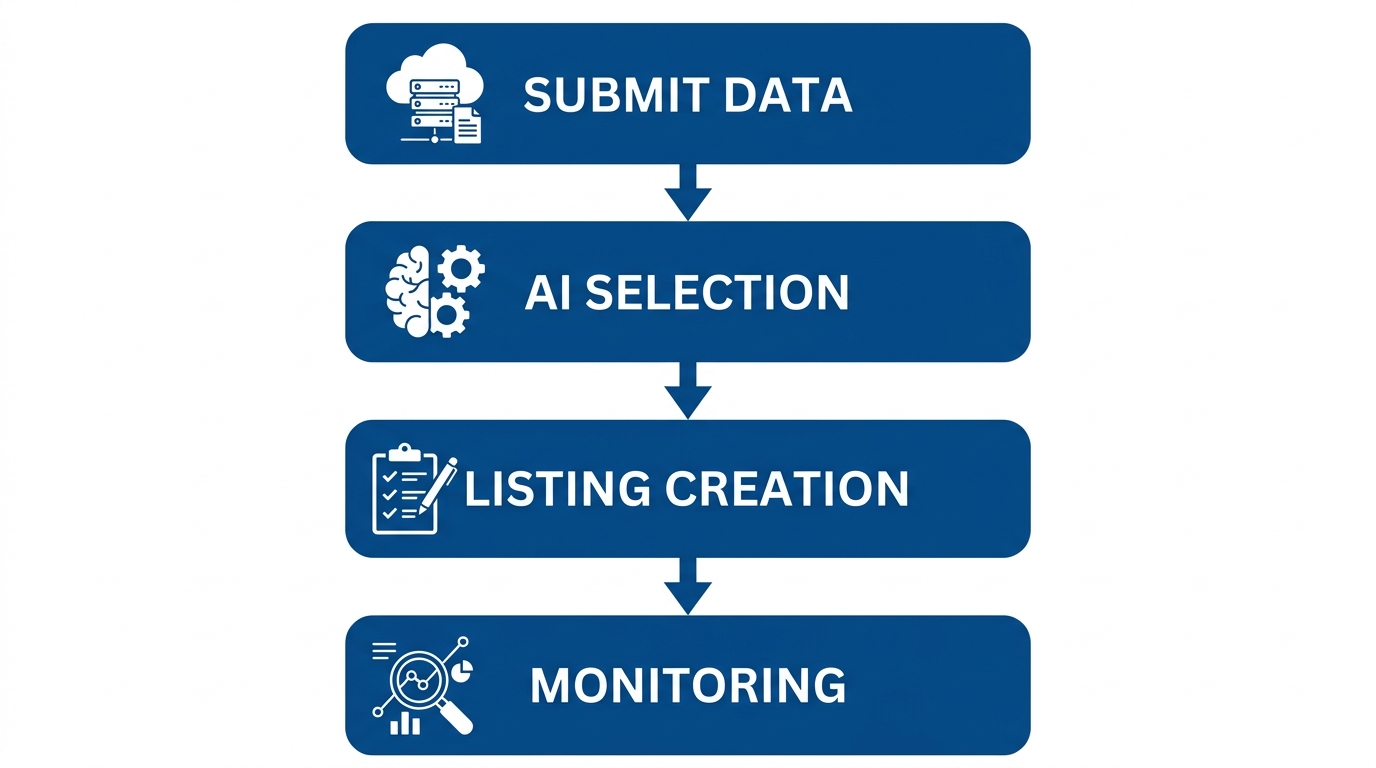
Automated citation service: four-step process from data submission to monitoring.
Step 1: Submitting Your Business Data Once
Getting started takes just minutes. You provide us with your foundational business details — once — and we handle the rest. The essence of our automation is that a single submission populates every future listing, eliminating repetitive data entry.
Your core information includes:
- Business name and physical address
- Phone number and website URL
- Primary business category
We never sell or rent your data. This one-time foundation powers consistent, accurate citations across the entire directory network.
Step 2: AI-Driven Directory Selection and NAP Distribution
For businesses comparing automated citation building services, directory relevance makes all the difference. Our AI-driven local SEO engine selects the most relevant directories for your business. Instead of a one-size-fits-all list, we prioritize a quality vs quantity approach, evaluating each platform by:
- Industry relevance (matching your category to directories where local customers actually search)
- Geographic focus — targeting directories popular in your served areas, from Miami and Florida to national and international markets
- Directory authority and trustworthiness
Once chosen, your Name, Address, and Phone number (NAP) are formatted to a single standard and distributed consistently across every directory. This uniformity reinforces your local signals far better than scattered, inconsistent entries could.
Step 3: Listing Creation and Optimization
We don’t just drop your NAP data into generic forms. Each listing is created and optimized to reflect your brand’s unique voice. We incorporate your business description, correct categories, operating hours, photos, and local-relevant details — customized to highlight your unique selling points and build trust with both search engines and potential customers. You can also customize the listing with your logo, service areas, and unique messaging, ensuring a consistent brand presence across the web.
The difference between manual effort and automated precision is striking. Consider how automated citation building services stack up against the do-it-yourself approach:
| Approach | Cost | Time | Consistency | Scalability |
|---|---|---|---|---|
| High labor cost | Predictable monthly fee | |||
| Hours per site | Minutes for multiple sites | |||
| Prone to errors | Highly consistent NAP | |||
| Hard to scale | Easily scales across locations |
Automation delivers consistent NAP data, faster distribution, and effortless scaling across multiple locations — with predictable, competitive pricing and no hidden commitments.
Step 4: Monitoring and Reporting
Your dashboard provides live tracking of every citation’s status. Our platform automatically flags duplicate listings — including Google Business Profile duplicates — so you can resolve conflicts quickly. Regular progress reports keep you informed of your growing citation footprint, all without manual oversight.
We are transparent about what the service does and doesn’t promise. SEPLQ does not guarantee specific ranking improvements — results may vary based on competition and industry conditions. Moreover, we never sell or rent your business data, as detailed in our Privacy Policy.
To complement our citation monitoring, you can also audit your website’s technical health with Semrush web design services through their comprehensive site audit tool.
Ready to put automation to work? Start your 30 day trial — no contract or commitment required.
Best Practices for Automated Citation Building in the US
| Approach | Cost | Time | Consistency | Scalability |
|---|---|---|---|---|
| High labor cost | Predictable monthly fee | |||
| Hours per site | Minutes for multiple sites | |||
| Prone to errors | Highly consistent NAP | |||
| Hard to scale | Easily scales across locations |
Directory Selection and Localized Targeting
Once you understand why citations matter, the next step is building them the right way. To maximize your local presence for automated citation building services in the US, focus on directories that directly influence local search rankings. Prioritize these US directories and data aggregators that feed the broader local ecosystem:
- Yelp, Yellow Pages, Bing Places
- Apple Business Connect, Facebook, Foursquare
- Angi, Better Business Bureau, Nextdoor
- Major aggregators: Infogroup, Neustar/Localeze, Factual
These directories and aggregators feed the data that search engines use to validate your business’s legitimacy. Our platform covers all high-value US directories, leaving no gaps. Our automated citation software submits your accurate business details to all these sources in minutes, replacing labor-intensive manual entry.
For Miami-based businesses, format your NAP with standard US suite/floor details and a local 305 or 786 area code. Target service-area neighborhoods like Brickell, Coconut Grove, Wynwood, Little Havana, and Coral Gables in your listing descriptions. This localized approach, powered by our AI-driven local SEO technology, helps clients see Fast SEO Results! — visible improvements often emerge within the first 30 days. Choosing the right directories is only step one — the real work starts with keeping those listings accurate.
Ongoing NAP Audits and Duplicate Removal
Even small NAP variations—St. vs. Street, missing suite numbers, or an old phone number—degrade local trust. Our automated citation building services in the US eliminate manual errors, delivering consistent NAP data across all directories. An automated citation building platform enforces the quality vs quantity approach by keeping every listing perfectly consistent, ensuring that search engines see your business as reliable.
Industry benchmarks show that citation signals correlate with local pack movement, making regular audits critical. We recommend a full NAP audit quarterly for single-location businesses and monthly for multi-location accounts. Using a citation audit tool, scan all directories to identify inconsistencies and duplicate listings. To resolve duplicates, follow this proven workflow:
- Search for common variations (abbreviations, alternate phone numbers, misspellings).
- Flag each duplicate in your tracking spreadsheet or dashboard.
- Request removal or suppression through the directory’s support flow or aggregator.
- Verify that the duplicate is resolved within 7–14 days and update your records.
Automated tools can flag most duplicates instantly, but manual review ensures that each request is properly handled and tracked. With clean, consistent listings in place, citations begin working alongside your Google Business Profile.
Integrating Citations with Google Business Profile and Review Management
Consistent citations across platforms like Apple Business Connect, Bing, and Yelp reinforce the trust signals Google uses to evaluate your business. As the table above shows, automated platforms maintain highly consistent NAP, which carries over into trust signals for Google. For a complete local presence, pair automated citation building with professional web design services such as Semrush web design services to ensure your site reinforces the trust your listings build. While no guarantee of specific ranking improvements exists and results may vary, we’ve seen that integrated citation and GBP strategies strengthen local authority. We invite you to experience the benefits with our 30-day trial and no contract or commitment, so you can see firsthand how our automated citation building platform powers your local growth.
Ready to Build Consistent Local Citations?
If you are tired of manual data entry, automated citation building services keep your NAP consistent across the web so you can stop chasing directory errors and start ranking. We make it simple with our AI-driven local SEO platform.
Compare the manual approach to our automated system:
| Approach | Cost | Time | Consistency | Scalability |
|---|---|---|---|---|
| High labor cost | Predictable monthly fee | |||
| Hours per site | Minutes for multiple sites | |||
| Prone to errors | Highly consistent NAP | |||
| Hard to scale | Easily scales across locations |
Industry benchmarks show citation signals correlate with local pack movement, and citations remain a foundational off-page local SEO tactic. Quality directory links also enhance authority, making consistent NAP a low-risk, high-impact investment. Our AI-driven local SEO platform automates the repetitive work so you can focus on what you do best.
Start your 30 day trial today—with no contract or commitment and competitive pricing, you risk nothing and gain a predictable monthly fee model. Often visible within 30 days, Fast SEO Results! are within reach when you let our AI handle citation consistency. We prioritize quality vs quantity in every directory placement, ensuring your local presence grows sustainably without endless manual hours.
Actionable Next Steps
- Request a website/local SEO audit to identify technical gaps and on-page opportunities.
- Claim and optimize your Google Business Profile, then install our plugin (with your consent) to create an administrative account and connect to our remote master server.
- Activate AI-driven citation building to push consistent NAP across high-authority directories.
- Monitor results in your analytics dashboard, including ranking reports, to track improvements.
Pair your consistent citations with a fast, technically sound website; explore Semrush web design services to audit your site before scaling your local presence. Start your 30-day trial today—no contract or commitment—and experience the power of automated citation consistency.
Disclaimers: Results may vary; client data is not sold or rented (refer to our Privacy Policy). SMS consent: reply STOP to opt out of messages; HELP for assistance; message and data rates may apply. Services require a minimum 3-month contract term; refunds only by mutual agreement. Liability is limited as per our Terms of Service governed by Florida law.