

Blog
Enterprise SEO Services: Complete Guide for 2026


Table of Contents
- Enterprise SEO Services: Meeting the Challenge of Scale
- Enterprise vs. Standard SEO: Key Differences in Scale and Complexity
- The Role of Generative Engine Optimization in Enterprise Search Strategies
- Mastering Crawl Budget and Site Architecture for Large Websites
- Transparent Performance Reporting and Best Practices for Local SEO
- Leveraging Link Building and Digital PR for AI Search Visibility
- Building an Enterprise SEO Strategy with SEOLocal
Enterprise SEO Services: Meeting the Challenge of Scale
enterprise seo services tackle the reality that managing growth at scale is rarely straightforward. An organization juggling locations in Miami, across the United States, and in over 25 countries must maintain a sprawling website and a constant flow of content—conditions that make optimization a deeply complex process.
Our integrated SEO and website design model gives enterprises a head start. From the first build, our website design services ensure that sites are technically sound, fast, and built for crawlability, turning optimization into a repeatable system. That foundation is essential when every new location or product page needs to rank without manual rework.
Fast SEO Results! Our consultative approach focuses on measurable improvements in visibility and lead generation, never over-promising but consistently delivering progress. To see how we meet this challenge, it helps to examine the key differences between enterprise and standard SEO in scale and complexity.
Enterprise vs. Standard SEO: Key Differences in Scale and Complexity
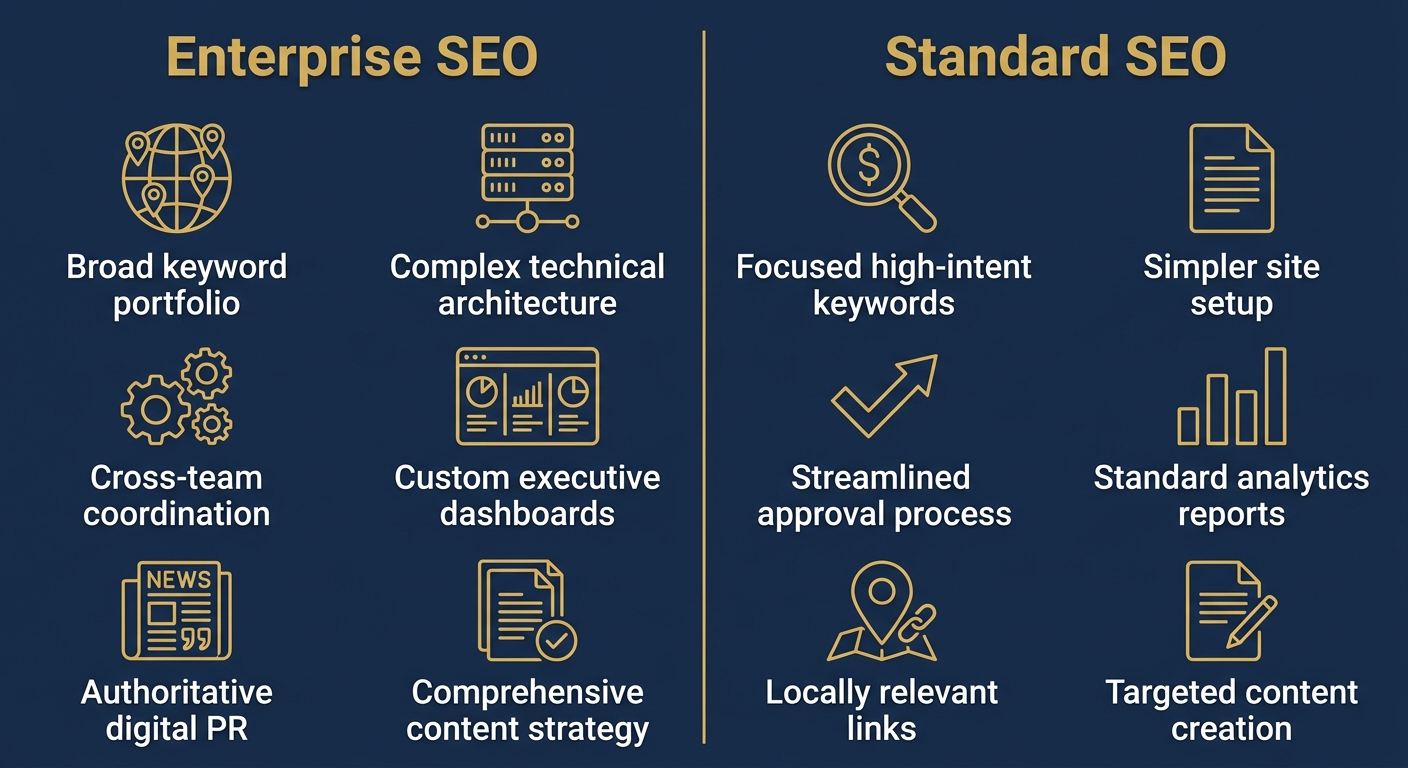
The scale challenges we outlined earlier — managing sprawling sites, coordinating cross-functional teams, and sustaining enterprise-level accountability — become most tangible when we contrast them with the tighter scope of a typical standard campaign.
| Dimension | Enterprise SEO | Standard SEO |
|---|---|---|
| Keyword Portfolio | Thousands of regional and niche queries across markets | Focused set of high-intent local terms |
| Technical Architecture | 100,000+ pages, crawl budget, canonicalization, CMS integration | Simpler setups with fewer indexing demands |
| Team & Process | Cross-departmental coordination and formal approval workflows | Small agile team with fast iterations |
| Reporting & Measurement | Custom dashboards and executive-level reporting | Standard analytics and periodic reports |
| Link Building | Digital PR and authoritative placements for brand trust | Locally relevant links through targeted outreach |
| Content Strategy | Multi-region, multi-format content aligned to brand segments | High-conversion local pages and niche intent content |
Our website design services deliver the technical backbone that enterprise sites rely on, ensuring massive content libraries crawl efficiently while maintaining clean canonical structures. Where standard programs can operate with straightforward analytics, enterprise engagements demand custom dashboards that aggregate data across business units, executive-level insights, and API-driven reporting aligned to broader organizational accountability.
In link building and content strategy, we apply the principle of quality vs quantity. Enterprise campaigns invest in digital PR and authority-building placements that strengthen brand trust over the long term, while local engagements thrive on genuine community links and tightly focused content.
Looking ahead, generative engine optimization is adding a new layer of complexity that neither enterprise nor standard programs can ignore. AI-driven search results demand structured data readiness, conversational content, and visibility in generative interfaces. Both models will need to plan for these capabilities, and we’ll examine them in detail next.
The Role of Generative Engine Optimization in Enterprise Search Strategies
The scale that complicates enterprise keyword strategies also shapes how AI engines discover and trust large sites. Generative Engine Optimization (GEO) addresses this by structuring content and technical signals so that AI-powered search engines—such as Google’s AI Overviews or conversational tools like ChatGPT—recognize your brand as a credible source and cite it within generated answers. It complements traditional click-based SEO by focusing on visibility in AI-generated responses, which is becoming a significant touchpoint for enterprise audiences.
For enterprise brands, earning those citations depends on authoritative, well-sourced content and consistent entity signals that establish trust. When your site publishes thousands of pages—from product descriptions to region-specific landing pages—the same crawl budget management discipline that underpins traditional SEO becomes critical. AI engines crawl and reindex at scale; if high-value assets are buried under low-priority URLs, they won’t surface when the engine assembles an answer. We ensure that our content strategies align with the topical authority and clear information architecture that AI models favor, just as they do for conventional search.
Technical foundation makes this possible. Our website design services deliver the fast-loading, crawlable architecture and structured data markup that both traditional crawlers and AI engines need to efficiently parse enterprise content. We also prioritize mobile performance, conversion tracking, and clear maintenance practices—backed by SLAs—to protect uptime, security, and long-term indexability and search visibility of priority pages. Proper schema implementation, logical internal linking, and clean site structures reinforce entity signals and help AI engines map your brand’s authority—transforming raw content into cited insights.
In the next section, we’ll unpack how mastering crawl budget and site architecture directly fuels both traditional and AI-driven search performance. At SEOLocal, we help enterprises build that technical foundation with no contract or commitment, so they can focus on the content that earns citations.
Mastering Crawl Budget and Site Architecture for Large Websites
For sites with thousands of URLs, effective crawl budget management ensures search engines spend their resources on your most valuable content. Crawl budget is the balance between crawl capacity—how often and how many pages a search engine can crawl—and crawl demand—which URLs are most worth indexing. For large-scale SEO efforts, getting this right prevents wasted crawls on low-value pages and keeps priority content indexed.
XML Sitemaps and Structured Signals
When a site exceeds 10,000 URLs, a well-organized XML sitemap becomes critical. We recommend splitting sitemaps by content type—products, blog posts, categories—and using lastmod and priority attributes strategically to guide crawlers. This helps search engines understand freshness, reducing the chance that new or updated content is overlooked.
Robots.txt Directives That Protect Crawl Budget
Carefully written robots.txt rules block crawlers from endless faceted navigation, filter parameters, and session IDs. We avoid rules that inadvertently block critical commerce pages such as cart or checkout.
Internal Linking and Site Depth
A flat internal linking architecture keeps essential pages within three clicks of the homepage. We use descriptive anchor text and distribute link equity from category pages and main navigation toward priority content, which reinforces topical authority. Keeping deep content discoverable minimizes orphan pages.
Canonicalization and Pagination
Duplicate content from www vs. non-www, HTTP vs. HTTPS, or parameter variants can fragment crawl signals. Implementing canonical tags consolidates authority onto a single preferred URL. For e-commerce category pages with multiple results pages, rel=canonical and rel=next/prev attributes signal the sequence and reduce crawler attention on redundant variants.
Log File Analysis and Diagnostics
Regular log file reviews reveal how search engine bots interact with your site. Combined with Google Search Console crawl stats, this analysis uncovers 404s, orphan pages, and crawl spikes on low-value URLs. A professional website audit can surface hidden architecture flaws and crawl budget leaks that even experienced teams might miss, giving you a clear diagnostic baseline for improvement.
Optimizing crawl budget and site architecture transforms technical SEO from a maintenance task into a measurable business lever. Once the foundation is efficient, the next step is to track performance improvements through transparent reporting and ongoing monitoring, ensuring every SEO investment delivers visible, accountable results.
Transparent Performance Reporting and Best Practices for Local SEO
Once crawl budget and site architecture are optimized for large sites, the real crux of enterprise-level local campaigns becomes proving the impact of that technical foundation. Transparent performance reporting and systematic local SEO best practices let clients see exactly how visibility growth translates into business results — without relying on black-box promises.
Our approach to reporting is built around live, self-service dashboards powered by an AI-driven local SEO platform. Rather than vanity metrics like raw impression counts, we focus on outcome-based KPIs: phone calls triggered by a local listing, direction requests, form submissions and Google Business Profile actions. Automated rank tracking and regular audit re-scans give every client a real-time view of progress, and we often see meaningful movement within the first 30 days (though we never guarantee a specific position). Because we work on a no-contract, competitively priced model, every data point becomes evidence of value delivered. We recommend a cadence of weekly monitoring check-ins backed by detailed monthly report reviews, so your team can adjust strategy as new trends emerge.
To turn reporting data into sustained growth, we apply these local SEO best practices:
- Consistent NAP citations across directories reinforce location authority for every business location.
- Google Business Profile optimization — including accurate hours, booking integration via partners like Square Appointments, and regular updates — improves local pack visibility and engagement.
- Proactive review generation and timely responses build social proof and signal relevance to search algorithms.
- On-page content tailored to local intent — service pages that answer neighborhood-level queries — ranks for the searches that drive foot traffic and calls.
- Local business schema markup makes your entity data machine-readable, increasing the likelihood of rich results.
- A fast, mobile-friendly website: we make sure every site follows local website design SEO best practices so that top rankings turn into actual revenue.
Transparent reporting also tracks the link acquisition and brand visibility metrics that feed into the next stage of an enterprise SEO strategy. Our work on link building and digital PR for AI-driven search visibility builds directly on the performance insights we’ve covered here.
Leveraging Link Building and Digital PR for AI Search Visibility
While transparent reporting demonstrates campaign performance, earning visibility in AI-powered search demands a distinct link-building and digital PR discipline. Search engines like Google AI Overviews, Perplexity, and ChatGPT now synthesize answers from sources they deem authoritative and contextually relevant—not simply those with the most backlinks. AI models also correlate consistent brand mentions across reputable local and national publications to verify expertise, making digital PR a vehicle for entity recognition. This shift means that securing citations from trusted publications, building topical authority, and earning consistent brand mentions all directly influence whether your content appears in AI-generated answers.
Digital PR Tactics for AI Search Visibility
Earning the citations AI search engines trust starts with editorial outreach that generates organic coverage. We design data-driven research campaigns—original surveys, local market statistics, and industry benchmarks—that journalists and niche publications naturally want to cite. When platforms like HARO seek expert commentary, supplying substantiated insights from your brand earns both backlinks and unlinked brand mentions. AI models treat these consistent mentions across reputable sources as signals of expertise, authority, and trustworthiness (E-E-A-T). The same discipline applies to content marketing: linkable assets such as case studies, interactive tools, or proprietary datasets become magnets for editorial links, reinforcing entity recognition.
The quality of a link matters far more than its quantity in an AI context. Citations from industry-relevant domains and respected niche blogs carry significantly more weight than hundreds of generic directory entries. AI search engines correlate a brand’s topical alignment across sources to determine relevance, so earning links from content closely related to your core services signals greater authority. Our website design services in Miami provide the fast, mobile-optimized, and visually credible foundation that makes your content link-worthy and your brand primed for digital PR coverage.
These link-building and PR strategies are a core component of any large-scale search visibility program. By combining our targeted high-quality link network with original data assets and consistent brand mentions, businesses can align with AI systems’ preference for relevance and authority—without guarantees or shortcuts. This integrated methodology is exactly how we build sustainable enterprise SEO roadmaps. In the next section, we detail how these elements fit into a complete strategy with SEOLocal.
Building an Enterprise SEO Strategy with SEOLocal
This article’s exploration of link building and digital PR shows how authority development is a critical pillar, yet it must operate within a comprehensive enterprise SEO framework. SEOLocal integrates AI-driven local optimization, automated content creation, link management, Google Business Profile management, and custom website design and development into a cohesive service. Our in-house web design team ensures technical SEO, page experience, and conversion architecture are engineered from the first wireframe. For enterprise organizations, this means a single partner that aligns all SEO disciplines under one strategy, eliminating the friction of multi-vendor coordination. We couple this with transparent reporting that gives you visibility into campaign performance. While we help clients achieve measurable progress, we do not guarantee specific ranking improvements, and results may vary by industry competition and algorithm updates. For organizations seeking enterprise seo services, we encourage you to reach out for a custom strategy backed by competitive pricing, a 30-day free trial, and no long-term commitment.
Start Your Enterprise SEO Journey
You’ve now explored the essential layers of enterprise SEO, from scaling content across large sites to leveraging generative engine optimization for AI visibility. Building on these strategies, SEOLocal provides a comprehensive solution that unifies AI-driven local SEO, content creation, and high-authority link building under one roof. Our platform automates technical tasks while giving you full transparency through custom dashboards and outcome-based reporting. We also integrate website design directly into your SEO foundation, ensuring every page is fast, crawlable, and conversion-ready. Many of our enterprise clients see measurable improvements within the first 30 days—without any long-term contracts. You can try our services risk-free with a 30-day trial and no commitment. Let’s discuss a custom plan that turns your enterprise search strategy into real growth.