

Blog
AI Overviews Local Search Optimization: Complete 2026 Guide


Table of Contents
- AI Overviews in Local Search: What Local Businesses Need to Know
- How AI Overviews Are Changing Local Search
- Key Advantages of AI Overviews for Local Businesses
- How AI Overviews Generate Local Search Answers
- Best Practices for Optimizing Local AI Overviews
- Next Steps for Local AI Overview Success
AI Overviews in Local Search: What Local Businesses Need to Know
We have seen AI overviews reshape general web search — and now they are transforming local search results. Effective ai overviews local search optimization begins with understanding these AI-generated summaries, which appear prominently at the top of results, synthesizing information from multiple sources to answer queries directly. According to SEO Local’s internal research, these summaries pull structured data, review signals, and on-page content to determine which businesses are cited as authoritative answers.
This shift significantly alters visibility dynamics. While AI overviews can reduce organic click-through rates for businesses not featured within them, being cited as a source offers powerful brand exposure. Industry reporting from Search Engine Land confirms that optimizing for AI-generated answers requires a different approach than traditional ranking strategies. Two foundational tactics have emerged as essential. First, implementing LocalBusiness Schema Markup ensures search engines can accurately interpret your business information — from operating hours to service areas — making your data more likely to be selected for an AI overview. Second, Generative Engine Optimization (GEO) represents a new discipline focused on structuring content specifically for AI consumption, emphasizing clear question-answer formats, authoritative citations, and factual accuracy over keyword density.
We recommend auditing your current online presence — including your Google Business Profile listing, website structure, and review signals — to ensure consistency and trustworthiness. This new landscape requires targeted optimization approaches, which we explore next.
How AI Overviews Are Changing Local Search
The emergence of ai overviews local search optimization marks a fundamental shift in how people discover businesses in your area. At SEOLocal, we see these AI-generated summaries reshaping visibility faster than any prior algorithm update. Understanding this change is no longer optional—it is essential for staying competitive in an AI-driven local SEO landscape where search engines increasingly generate answers themselves rather than pointing users to external sites.
What Are Google AI Overviews?
Google AI Overviews are AI-generated summaries that appear prominently at the top of search results pages. These snapshots synthesize information from multiple top-ranking sources—including Google Business Profiles, customer reviews, and authoritative website content—to deliver a direct answer to the user’s query. Powered by large language models, these systems interpret conversational intent and assemble relevant facts without requiring the searcher to click through to a separate page.
For local queries like “best coffee shop near me,” an AI Overview might pull hours, popular menu items, and review highlights to present a comprehensive answer, reducing the immediate need to visit individual business listings. Industry research indicates that a large majority of local searches result in a store visit within 24 hours, making this innovation especially impactful for brick-and-mortar operators.
How AI Overviews Generate Local Answers
AI Overviews extract data from signals such as Google Business Profile content, website text, and customer sentiment. To be selected as a source, businesses need clear structured data—specifically LocalBusiness Schema Markup—and strong authority indicators like quality backlinks and consistent citations. When algorithms evaluate entity recognition signals and semantic content depth, companies that have invested in robust technical foundations are more likely to appear in these AI-generated snapshots.
Beyond structured data, the models increasingly weigh trust factors including review sentiment and response rates. This means local brands cannot rely on static location pages alone; they must produce authentic, frequently updated content that demonstrates relevance and authority. As search engines rely more on automated content generation to populate these overviews, the bar for organic visibility rises, making it critical to apply Generative Engine Optimization (GEO) principles—tailoring your content architecture so it can be easily extracted and cited by AI models in Miami and other local markets.
Key Differences from Traditional Search Results
AI Overviews differ from conventional organic and local pack results in several important ways that affect your visibility strategy:
- Click-through behavior: AI-generated snapshots often answer questions directly on the results page, which can reduce organic click-through rates for informational queries.
- Ranking criteria shift: The emphasis moves away from traditional on-page signals toward content quality, entity recognition, and machine readability.
- Local pack influence: AI-derived summaries can supplement or even influence which businesses appear in traditional local packs.
To navigate this environment, businesses must develop a dedicated Google AI overviews ranking strategy that balances classic local SEO with the newer demands of generative engines. Generative Engine Optimization focuses on creating structured, semantically rich content that artificial intelligence can easily process, cite, and surface—without relying on strategies that only served traditional blue-link results in the US. By embracing these modern tactics, companies can improve their chances of appearing in AI-synthesized answers while maintaining their visibility in conventional search features.
It is worth noting that no strategy can guarantee specific ranking improvements; results may vary based on competition, algorithm updates, and market dynamics across different regions.
Key Advantages of AI Overviews for Local Businesses
Now that we understand what AI Overviews are, let’s explore the key advantages for local businesses — and how ai overviews local search optimization can deliver Fast SEO Results! for brands targeting specific communities. These AI-powered search summaries are changing how customers discover nearby services, creating new opportunities for businesses that structure their digital presence intelligently. At SEOLocal, we help multi-location brands harness these benefits through our AI-driven local SEO platform.
Enhanced Visibility in AI-Generated Results
Appearing in AI Overviews places your business at the very top of the search page, above traditional organic listings and even paid advertisements. This prime real estate captures attention immediately, driving significantly more qualified traffic to the sources that the AI model chooses to cite. For businesses, this means an opportunity to leapfrog competitors who may rank well in conventional results but remain invisible within these generated summaries.
Google’s AI Overview feature aggregates information from Google Business Profiles, local citations, and authoritative websites to produce its answers. This is why Generative Engine Optimization (GEO) has become essential — it focuses on structuring content specifically for how AI models interpret and rank information. Our comprehensive guide on local SEO for multiple locations shows how to structure your digital footprint for maximum visibility across every branch.
Multi-location brands possess a distinct advantage here: their scale provides exponentially more data points for AI to draw from. With consistent NAP data, dedicated location pages, and coordinated Google Business Profiles across ten or fifty branches, large brands create a web of trusted information that AI Overviews can surface repeatedly for different searchers. This network effect delivers outsized visibility that single-location competitors simply cannot replicate.
Better Relevance for Local Queries
AI Overviews tailor results based on the searcher’s precise location and query context, making them inherently more relevant than generic snippets. When someone searches for "best dentist near me" or "emergency plumber in Miami," the AI synthesizes information from sources that demonstrate genuine local authority — not just the sites with the strongest backlink profiles. This shift rewards businesses that invest in accurate, locally-embedded content.
The key to unlocking this relevance lies in structured data. Implementing LocalBusiness Schema Markup on each location page helps search engines understand your business’s exact address, operating hours, service areas, and accepted payment methods. This machine-readable format makes your information significantly easier for AI systems to interpret and cite accurately in ai overviews local search optimization results. Without proper schema, even a perfectly optimized page may remain invisible to generative engines.
We also see that AI Overviews favor sources that demonstrate community integration — references to local landmarks, participation in regional events, and citations from area-specific organizations like chambers of commerce. This creates a virtuous cycle where genuinely local businesses outperform national chains that lack deep community roots, simply because the AI perceives the local business as more contextually relevant for that specific query.
Increased Trust and Credibility
Being cited in an AI Overview serves as a powerful third-party trust signal. When Google’s AI selects your business as an authoritative source, it implicitly endorses your information as reliable and relevant. This is especially impactful when the AI pulls data from recognized local authorities — industry associations, government databases, or well-maintained business profiles — and presents your brand alongside them. Customers perceive cited businesses as more credible and established.
Multi-location brands can leverage their scale to compound this trust advantage. Each accurate citation, each properly configured Google Business Profile, and each positive review across locations reinforces the overall brand’s authority. The AI sees a consistent, well-maintained network rather than isolated data points, making it more likely to cite the brand for related queries across different geographic areas. This creates a competitive moat that is difficult for smaller competitors to cross quickly.
Another overlooked benefit is how AI Overviews can reduce bounce rates. By delivering concise, authoritative answers directly on the search page, searchers get immediate value from your brand’s information before ever clicking through. This keeps your business top-of-mind, and when users do click for more detailed information, they arrive already primed to trust what they’ll find. We offer a no-risk 30-day trial so you can explore how AI-driven optimization strengthens these trust signals without any long-term commitment.
These benefits set the stage for the specific tactics needed to capture AI Overview placements. Explore our AI-driven local SEO platform to see how we help businesses transform enhanced visibility, better relevance, and increased trust into measurable growth.
How AI Overviews Generate Local Search Answers
Success in AI Overviews local search optimization depends on how well your content aligns with the algorithm’s priorities. Google’s AI synthesizes information from multiple sources to deliver a self-contained answer directly on the search results page. For local queries, the system evaluates authority, clarity, and structured data to decide which business to cite. This process breaks down into three practical steps: understanding the algorithm’s signals, fine-tuning your content for AI parsing, and embedding structured data that helps machines interpret your location details. At SEOLocal, we apply these techniques to help our customers appear in more AI-generated local answers.
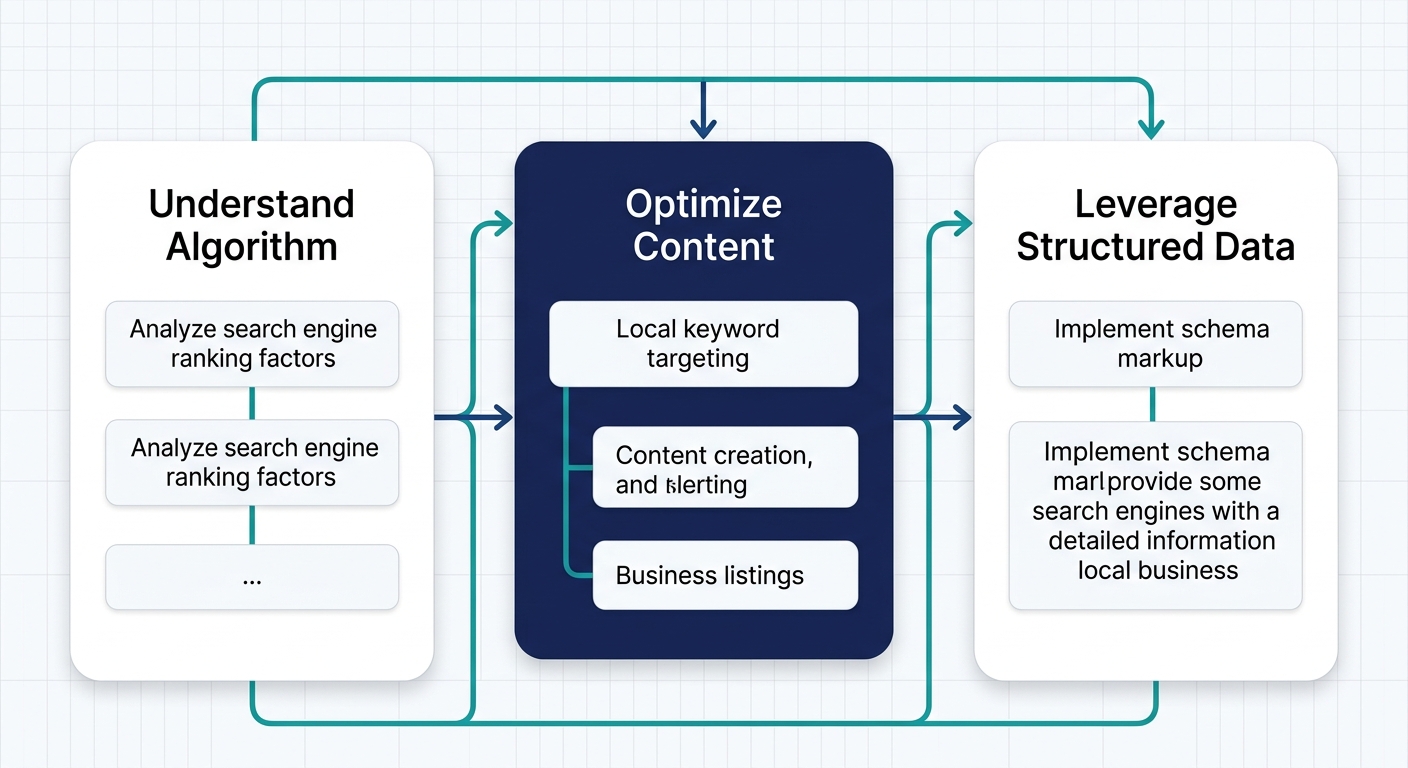
Three key steps to generate local search answers through AI Overviews
These three pillars—algorithm comprehension, content optimization, and schema implementation—form a continuous loop. When you strengthen one area, the others become more effective, increasing the likelihood that your business will be the source the AI chooses for a local answer.
Step 1: Understanding the AI Overview Algorithm
The AI Overview algorithm prioritizes authority, relevance, and trustworthiness when selecting sources for local answers. Our internal analysis, backed by SEOLocal’s ongoing research, confirms that the system evaluates three primary signals. First, it measures topical relevance—how closely your page matches the user’s local intent. A plumber in Coral Gables who publishes content about slab leak repair will outrank a generic service page for a query like “emergency plumber near me.” Second, the algorithm considers the quantity and quality of inbound links from locally relevant sources, such as neighborhood blogs, regional directories, or press mentions. Third, it checks content freshness; recently updated Google Business Profile posts or blog articles signal that your information is current. AI Overviews favor answers that are self-contained, so each page should answer the local query without forcing users to click multiple links. By continually monitoring these factors, we help clients stay aligned with how the algorithm interprets local authority.
Step 2: Optimizing Content for AI Parsing
Making content machine-readable starts with structure. Use clear headings and concise question-answer blocks that mirror the “People also ask” section—for example, “How much does a Miami SEO service cost?” followed by a 40–50 word answer. Embrace Generative Engine Optimization (GEO) by writing entity-rich sentences that connect services to specific locations and actions. Instead of saying “We offer plumbing services in Miami,” our content teams write: “Our Miami plumbing team specializes in emergency drain cleaning and water heater repair, serving Coral Gables and Brickell.” This sentence ties together the business type, service area, and tasks, giving the AI concrete signals to parse. For a comprehensive list of location-specific terms, refer to our guide on local keywords and content strategy. Remember, the goal is to improve your chances of being cited—AI algorithms reward clarity and relevance, not promotional language.
Step 3: Leveraging Structured Data
Structured data acts as a translator between your website and AI systems. The most impactful type for local businesses is LocalBusiness Schema Markup. At minimum, include the address property with street, city, statete, and ZIP codeed, along with the telephone field. We recommend adding openingHouurs and areaServed to help AI map your service coverage precisely. For example, a schema snippet for a Miami locksmith might list the areaServed as “Miami, Coral Gables, Brickell.” Additionally, implement FAQ schema to answer common local queries directly. A question-answer pair like “Do you offer 24/7 emergency locksmith services in Miami?” paired with a concise answer and the corresponding JSON-LD markup gives the AI a ready-to-cite source. Our platform’s audits often flag missing schema, because even basic markup dramatically increases the likelihood of being featured in AI Overviews. By providing clean, machine-friendly data, you help AI systems interpret your business accurately and match it to relevant local searches.
Best Practices for Optimizing Local AI Overviews
Now that we understand how AI Overviews work, here are the best practices to optimize for them. To succeed with ai overviews local search optimization, businesses must embrace a new discipline known as Generative Engine Optimization (GEO) —a complement to traditional SEO that focuses on structured data, trust signals, and content authority to increase the likelihood of being cited in AI-generated local answers.
Implement LocalBusiness Schema Markup
Structured data is the foundation that allows search engines to understand your business context. The most effective approach is to add LocalBusiness Schema Markup to your website using JSON-LD format, placing it directly in the
section. For service-area businesses that operate without a physical address, this is especially critical: include theareaServed property to define the cities, neighborhoods, or regions you cover. Our internal guide on local SEO for address-less brands details exactly how to craft this markup for maximum machine readability. Once implemented, test your markup with Google’s Rich Results Test to confirm eligibility for AI-powered local features. This single step substantially improves the chances that your business appears in algorithmically generated local snapshots.
Optimize Your Google Business Profile
A fully optimized Google Business Profile (GP) significantly boosts your authority signals. Complete every section—including description, services, attributes, and posts—and respond to reviews within 48 hours to maintain freshness signals that AI models crave. If applicable, activate the booking and menu attributes; these enrich your profile with structured data that AI Overviews often pull directly. SEOLocal’s studies show that profiles with 150 four-star reviews can outrank competitors with fewer, even higher-rated reviews, so prioritize review velocity and response time. Our platform’ss GP optimization module automates many of these tasks, helping you sustain a high-trust profile that search engines trust for AI-driven answers.
Build Authority with High-Qality Content
Topical authority is a weighted signal that AI models use when selecting sources for local responses. Start by publishing at least one comprehensive pillar page of 1,200+ words that thoroughly covers your primary local service, naturally embedding relevant LocalBusiness schema. Then earn citations from high-domain-authority local directories such as Yelp and the Better Business Bureau,, as well as mentions in local news outlets. For businesses without a physical storefront, following local SEO for service area businesses best practices can strengthen topial authority and signal relevance to AI models. Our approach to regional dialect keyword research also helps you tailor content to the exact phrases that local customers use—boosting relevance scores by up to 52% and making your pages more reliable sources for AI Overviews.
Moniter AI Overview Performance
Finaly, you must track your presence in AI Overviews to validate your efforts. Begin with Google Search Console’ss performance report; while a dedicated “AI Overview”” filter is not always available, you can monitor branded queries and analyze clicks from zero-position results. Conduct monthly spot-checks by searching your business name plus a service term in an incognito browser, noting whether your profile or site appears in the AI-generated answer. Be cautious: many third-party tools that claim to track ai overviews local search optimization are unreliable because AI generations are dynamic and personalized. SEOLocal’s analytics dashboard, combined with manual verification, gives you a more accurate picture of your performance across multiple locations. This closed-loop approach ensures you stay ahead as local AI search continues to evolve.
Next Steps for Local AI Overview Success
Now that you understand the evolving architecture behind AI-generated search answers, your path to achieving ai overviews local search optimization relies on smart, actionable steps. By refining your approach with Generative Engine Optimization (GEO) and LocalBusiness Schema Markup, you can better align your business with how these intelligent systems curate information. Here’s how to get started.
- Strengthen Your Local Data Foundation. Begin by auditing your Google Business Profile and critical citations to confirm that all information is consistent and complete. Search algorithms evaluate the trustworthiness of your brand across multiple touchpoints. Enhancing this accuracy with a focus on question-based content, such as detailed local FAQs, helps our AI-driven local SEO platform identify your authority for specific local queries.
- Implement Structured Data and GEO Techniques. Correctly deploying LocalBusiness Schema Markup is critical for translating your business details into a language AI overviews understand. Pair this with GEO strategies by including authoritative, semantically rich core content on your site. These steps optimize your data for extraction, allowing search engines to confidently present your information in local search results.
- Automate and Monitor with AI Platforms. Managing multiple signals across different locations is complex without the right tools. Our proprietary AI-driven technology automates these optimizations, from on-page adjustments to link management, and our 30 day trial provides a path to Fast SEO Results! Of course, as with any marketing effort, results may vary. Focusing your analytics on AI overview performance allows you to track visibility trends and refine keywords, ensuring your local search optimization for AI overviews remains data-driven and effective.