

Blog
Best AI Digital Twins for Marketing in 2026: Top Tools

Table of Contents
Navigating AI Digital Twins for Smarter Marketing
According to Search Engine Land, leveraging AI digital twins for marketing in Miami and nationwide allows businesses to simulate customer behavior and test campaigns without risking real budgets. For local enterprises, digital twin technology provides a sandbox for innovation, enabling marketers to refine strategies before full deployment.
Core to this approach is AI persona cloning, which constructs hyper-personalized audience models from existing customer data, while conversational AI brand voice ensures consistent brand messaging across simulated interactions. These technologies enable us to forecast engagement and tailor content with precision, reducing the guesswork in campaign planning.
When integrating digital twin strategies with social media management, comparing tools like Sprout Social vs Brand24 can reveal which platform better aligns with your workflow and data needs. Insights from such comparisons help marketers identify features that complement persona simulations and brand voice integration in real-time campaigns.
Our AI-driven local SEO with no contract or commitment and a 30-day trial delivers Fast SEO Results! In the following section, we’ll see how a local business achieved measurable results with this approach.
Preparing Your Marketing Environment for AI Digital Twins
Before deploying your digital twin, your marketing environment must be ready. Here’s how to prepare for integrating ai digital twins for marketing.
Current Technology Stack Assessment
According to industry best practices from CXL, we recommend a thorough inventory of your current marketing technology stack to ensure compatibility and data sufficiency. Key actions include:
- Document all marketing channels, data sources (CRM, email, social media), automation tools, and analytics platforms currently in use.
- Include specific CRM systems such as Salesforce and HubSpot, along with analytics tools like Google Analytics and Google Business Profile Insights.
- When inventorying your social listening tools, a side-by-side comparison of Sprout Social vs Brand24 can help you decide which platform supplies the best engagement data for your digital twin.
- Identify essential data points for accurate ai persona cloning and a consistent conversational ai brand voice: customer interaction history, conversion data, engagement metrics, and brand voice examples.
- Ensure GDPR and CCPA compliance for all platform connections.
Integrating with Existing Analytics
Seamless integration with your current analytics platforms is critical to feeding real-time data into your AI digital twin. To power your ai digital twins for marketing, integrate Google Analytics and Google Business Profile Insights via API or structured data imports. We suggest:
- Verify API availability and authentication methods (OAuth, API keys) for each analytics platform; confirm support for JSON and CSV data formats.
- Evaluate direct API connections, CSV/Excel imports, or middleware solutions like Zapier for consistent data flow.
- Prioritize data points essential to twin accuracy, such as conversion events, page engagement, and profile insights.
- Follow IAB integration standards to maintain compliance and data integrity.
With your tech stack assessed and analytics connected, you’re ready to bring your AI digital twin to life.
Define Your AI Digital Twin Strategy
Now that you understand ai digital twins for marketing, defining your twin’s role—customer service, lead generation, or brand representation—is the first step to success.
Instructions
Decide on a primary purpose. For ecommerce, the twin can recommend products and recover abandoned carts. If brand representation is the goal, it must convey your conversational ai brand voice through ai persona cloning. For a local service business in Miami, it can answer questions and schedule appointments. Align with one use case, then define metrics like response time or lead volume.
Why It Matters
We know that a well-defined strategy for your ai digital twin for marketing prevents wasted effort. Tying the twin’s actions to KPIs like conversion rate and customer satisfaction ensures the investment supports real growth.
Tips
Start with one use case to test effectiveness. Involve marketing, sales, and support teams to shape the twin’s persona and limits. Document target metrics upfront, such as engagement rate. Finally, use tools like Sprout Social vs Brand24 to track brand mentions and interactions.
Collect and Integrate Marketing Data Sources
Instructions
To build effective AI digital twins for marketing, we must first gather and unify the right data: customer interaction logs (email opens, clicks, support chats), sales transactions, website behavior (page views, sessions, conversion funnels), and review data. Pull these via REST APIs from CRMs, email platforms like VerticalResponse, or analytics tools, or export as CSV for batch processing into a central repository.
Why It Matters
The accuracy of AI digital twins for marketing depends on clean, complete data. Poor data leads to flawed personas and wasted spend, while a well-integrated dataset enables accurate predictions and reliable automation that may improve campaign performance over time.
Tips
Cleanse data by removing duplicates and normalizing formats. For large datasets, use a data warehouse. Always review privacy regulations (GDPR, CCPA) and obtain consent before ingesting personally identifiable information. When building AI persona cloning and conversational AI brand voice models, consult IAB’s guidance on selecting conversational AI for brand voice.
Once our data is integrated, we can move to building the twin’s behavior model.
Build an AI Persona Clone for Your Brand
Now that you understand the value of AI digital twins, here is how to build one for your brand.
Instructions
- Compile your brand guidelines – tone, vocabulary, and do/don’t rules.
- Gather past campaign assets – emails, social posts, ad copy.
- Collect customer communication logs – chat transcripts, support tickets.
- Train the AI model on these inputs to begin ai persona cloning.
- Review output for consistency against your brand voice.
Why It Matters
Adopting ai digital twins for marketing ensures every customer interaction – from emails to social responses – feels cohesive. An AI-driven persona clone eliminates mixed messaging and builds trust, so your audience always hears one clear voice.
Tips
- Include competitor analysis to differentiate your brand persona.
- Update the clone quarterly with new campaigns and feedback.
- A/B test variations of your conversational ai brand voice. For a deeper look at available platforms, see our best ai digital twin marketing tools comparison. Once built, you can track its impact on engagement and refine over time.
Implement Conversational AI Brand Voice
Once your AI persona is cloned, the next step is to integrate it into your conversational channels.
Instructions
Follow these steps to integrate the persona into your conversational channels:
- API Integration: Connect the cloned persona—a result of AI persona cloning—to web chat, SMS, and Google Messages using our API endpoints, enabling seamless real-time conversations.
- Configure Response Templates: Define tone parameters, vocabulary preferences, and pre-built templates that enforce the brand’s voice, ensuring uniform customer interactions across all channels.
- Define Escalation Paths: Set rules for human handoff when the AI cannot handle a query or detects frustration, and configure fallback responses to maintain customer satisfaction.
Why It Matters
A consistent conversational voice increases customer trust and reduces friction in local lead generation. Leveraging AI digital twins for marketing ensures this consistency, and understanding how to use AI digital twins for customer retention strengthens long-term client loyalty.
Tips
- Use a hybrid model (AI + human handoff) for complex queries.
- Test your conversational AI brand voice on web chat, SMS, and Google Messages.
- Monitor sentiment in real time to adjust tone proactively.
- Iterate based on performance data. After implementation, use analytics to optimize responses.
Synchronize Digital Twins with Live Sales Data
Static digital twins lose marketing value quickly. To keep them relevant for personalized outreach, we connect each twin to live sales data from your CRM or e-commerce platform.
Instructions
Follow these steps:
- Establish a read-only API connection to your sales platform (e.g., CRM, online store) so we can pull recent events without risking data corruption.
- Configure webhooks to push real-time updates on purchases, leads, or cart abandons.
- Map those sales events to trigger behavior changes in your ai digital twins for marketing—for instance, sending a personalized discount after a purchase.
Why It Matters
Live data ensures that each twin reflects recent customer activity. It enables timely follow-ups and supports AI persona cloning for more relevant offers. Without synchronization, the twin becomes a stale snapshot, missing opportunities.
Tips
- Start with a sandbox environment to test your API connections before going live.
- Implement error handling so that a failed update does not break the twin’s logic.
- Use read-only access initially; expand write permissions only after thorough testing.
- Verify that the conversational AI brand voice remains on-brand after each synchronization.
Once synchronized, these digital twins enable real-time engagement scenarios.
Deploy Digital Twins for Local SEO and GBP Optimization
Now that you understand the concept, here is how to deploy digital twins for Local SEO and GBP optimization. AI digital twins for marketing are transforming how local businesses engage customers through GBP, offering persistent, on-brand interactions that capture leads around the clock.
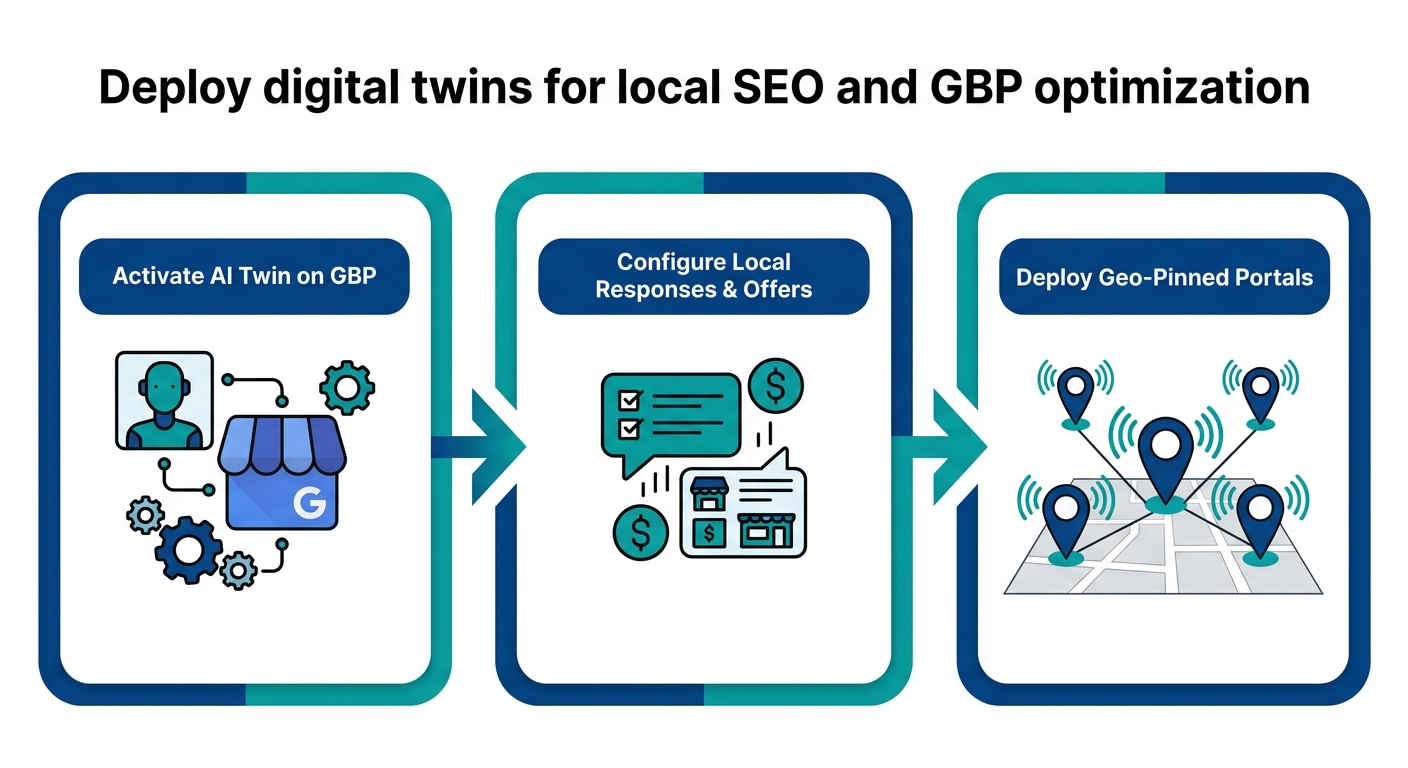
Deploy digital twins for local SEO and GBP optimization.
Instructions
- Connect the digital twin to your GBP listing through SEOLocal’s integration (start with the 30-day trial, no contract required) and use AI persona cloning to replicate your authentic brand voice.
- Configure location-specific responses and offers—for example, define distinct service areas and promotions for a business operating in Miami versus international markets.
- Deploy geo-pinned portals for each location; SEOLocal’s documentation confirms these capture high-intent leads directly from map-native search.
Why It Matters
AI digital twins for marketing enable 24/7 lead generation by answering service-area questions and managing reviews. This persistent presence turns map views into qualified inquiries without manual oversight.
Tips
- Use separate geo-pinned portals per location to maintain hyperlocal relevance.
- Update service details regularly and employ a conversational AI brand voice for natural replies.
- Monitor map ranking changes after deployment to refine your approach.
Monitor Performance and Continuously Optimize
Once your AI digital twins for marketing are live, monitoring becomes essential. We recommend setting up dashboards for engagement metrics (click-through rates, conversation length), conversion attribution (lead generation, sales assisted) using tracking links, and voice consistency (sentiment alignment with brand guidelines). Schedule weekly reviews to catch drift early and A/B tests on twin responses or persona tweaks every two weeks, and adjust based on findings.
Why It Matters
Market conditions and customer preferences shift continuously. Without regular monitoring, an AI digital twin for marketing grows stale, reducing potential ROI. Continuous optimization—updating tone, training data, and response strategies—keeps the twin aligned with customer behavior, maximizing impact.
Tips
- Combine social listening tools like Sprout Social and Brand24 with twin analytics to cross-reference sentiment (our internal comparison shows they complement each other).
- Track sentiment drift and re-train the model quarterly to incorporate new language patterns.
- Use monitoring insights to refine the twin’s ai persona cloning and conversational ai brand voice.
From here, you can dive into advanced strategies to further enhance performance.
Common Challenges and How to Resolve Them
While implementing AI digital twins for marketing unlocks powerful predictive capabilities, two practical obstacles can hinder success: payment security and data synchronization. Our experience in AI-driven local SEO has shown that proactively addressing these challenges ensures reliable, high-speed performance.
Payment Security Concerns with Digital Twins
Token expiration is a frequent pain point when digital twins interface with third-party billing APIs. We recommend implementing automated token rotation and renewal workflows to maintain uninterrupted payment sessions. API rate limits can also bottleneck high-frequency transactions, so we suggest integrating queuing mechanisms or selecting processors with higher throughput. For maximum protection, we advise using PCI-compliant processors like Stripe; their tokenized connections dramatically reduce exposure of sensitive cardholder data. As we deploy ai persona cloning for personalized marketing, securing payment flows preserves customer trust. Our infrastructure handles high-volume API calls within a tokenized environment, ensuring that financial data never touches our servers while adhering to PCI DSS standards.
Data Synchronization Errors
When managing AI digital twins for marketing, data synchronization errors typically stem from network latency or conflicting updates when multiple twin instances modify the same record. We employ conflict resolution strategies such as last-write-wins or timestamp-based merging, ensuring the most recent accurate data prevails. For proactive monitoring, we integrate webhooks or middleware like Zapier—or develop custom Node.js listeners—that trigger alerts on sync delays. A crucial diagnostic step is enabling detailed logging on both source and twin endpoints to pinpoint exactly where latency originates. When maintaining a consistent conversational AI brand voice across all customer touchpoints, these sync safeguards dramatically reduce the risk of message inconsistency or data loss. By implementing timestamp-based merging and webhook monitors, we’ve found that sync failures become rare, allowing businesses to confidently integrate AI-powered customer avatars and maintain a brand-aligned AI dialogue. With these challenges resolved, our platform delivers Fast SEO Results! through secure and synchronized digital twin operations.
Take the Next Step with AI-Powered Local Marketing
Now that you understand how ai digital twins for marketing can create hyper-targeted personas without manual segmentation, it’s time to put that capability to work for your business. Our platform makes it easier than ever.
With AI persona cloning, you can scale personalized content across local listings at a fraction of the time, embracing a quality vs quantity approach. Meanwhile, our conversational AI brand voice ensures consistent, engaging communication on social media and directory pages, helping you stand out without overspending. This automated personalization keeps your brand voice true across every touchpoint, driving engagement and local relevance.
Explore our extensive knowledge base and case studies to see the results we’ve delivered for businesses like yours. Start your 30 day trial with no contract or commitment and experience Fast SEO Results! While individual results vary and we cannot guarantee specific rankings, many clients see measurable improvements quickly. Our AI-driven local SEO delivers measurable improvements within 30 days. Ready to get started? Contact our team to begin.