

Blog
SEO Copywriting and Blog Content That Ranks: A Complete Guide


Table of Contents
- Why SEO Copywriting Matters for Local Businesses
- Fundamentals of SEO Copywriting and Blog Content That Ranks
- Deep Dive: Technical On‑Page Optimization for Local SEO Content
- Practical: Implementing Your AI‑Driven Local SEO Copywriting Workflow
- Advanced: Scaling Local SEO Content with Analytics and Automation
- Frequently Asked Questions About SEO Copywriting and Local Visibility
- Taking Your Local SEO Content to the Next Level
Why SEO Copywriting Matters for Local Businesses
SEO copywriting and blog content that ranks is the practice of creating search-optimized content that appears when nearby customers search for local services, turning casual browsers into real leads. For local businesses, being visible in those moments means the difference between a full appointment book and an empty one. When someone nearby searches for a service you offer, content built to rank puts your name in front of them right when they need it.
At SEOLocal, we believe local businesses gain greater value from strategic content than just local search visibility. SEO copywriting is a craft where the right keywords are researched and strategically incorporated in a piece of content in a way that provides value to the end reader. It helps to position a business as a trusted authority in the field and encourages more local engagements. Trust is earned over time and it is ultimately the difference between a business with a constant flow of local engagements and a business that requires continuous outreach to gain new customers.
The key to great SEO copywriting is aligning content with the end goal of a business. Is it more appointments? More sales? More service requests? The answer dictates the kind of SEO copywriting that needs to be done to achieve that goal. We channel our understanding of SEO copywriting toward visibility and directly help your business move toward growth with each piece of content produced. Great copywriting drives great content and ultimately, it’s blog content that ranks that helps you communicate your brand message to your ideal customers and motivate action. Understanding the core principles of SEO gives us the ability to design blog content to rank.
Key Takeaways
- Effective SEO copywriting combines persuasive writing with technical precision so that every page serves both the reader and search engines.
- We aim, for every client project, to first ensure the underlying on-page elements are configured to satisfy both user expectations and algorithmic requirements.
- After setting the technical foundations for local SEO, the next logical step is to implement an efficient content creation workflow.
- Automation has not fully replaced copywriting.
- We’ve covered keyword research, on-page optimization, and Google Business Profile alignment.
Fundamentals of SEO Copywriting and Blog Content That Ranks
Effective SEO copywriting combines persuasive writing with technical precision so that every page serves both the reader and search engines. It is the practice of researching, structuring, and drafting content around verified keywords while keeping the user’s question at the centre of the narrative, and it forms the foundation of content that earns visibility in organic results.
Most blog content targets informational intent, meaning the visitor is looking for explanations, comparisons, or how-to guidance. When the article delivers a complete, authoritative answer and uses related terms naturally, search engines recognize its relevance and reward it with higher impressions.
Keyword stuffing triggers spam filters and degrades readability, so modern SEO copywriting treats keywords as signposts rather than quotas.
Search engines assess the quality and quantity of material on a site. Focusing on original research, local examples, and clear formatting signals expertise more reliably than rapid-fire publishing, particularly for businesses that depend on neighbourhood visibility.
Here is a summary of how each of these elements functions within the context of local SEO.
| Ranking Factor | What It Means for SEO | Local SEO Impact |
|---|---|---|
| Content Quality | Well-researched, original content that thoroughly answers the user query and follows on-page best practices. | Helps a business appear for neighbourhood-specific searches by addressing local topics, landmarks, and service-area details. |
| Backlinks | Links from relevant, authoritative websites that act as third-party endorsements of trustworthiness. | Local citations and links from community organisations, directories, and media outlets strengthen geographic relevance signals. |
| User Experience | Fast load times, mobile-friendly design, clear navigation, and accessible formatting that keep visitors engaged. | Satisfies mobile-heavy local search traffic and reduces bounce rates on location pages, improving the site’s behavioural metrics. |
Content quality remains the anchor because even strong backlinks and fast pages cannot compensate for thin or duplicated material.
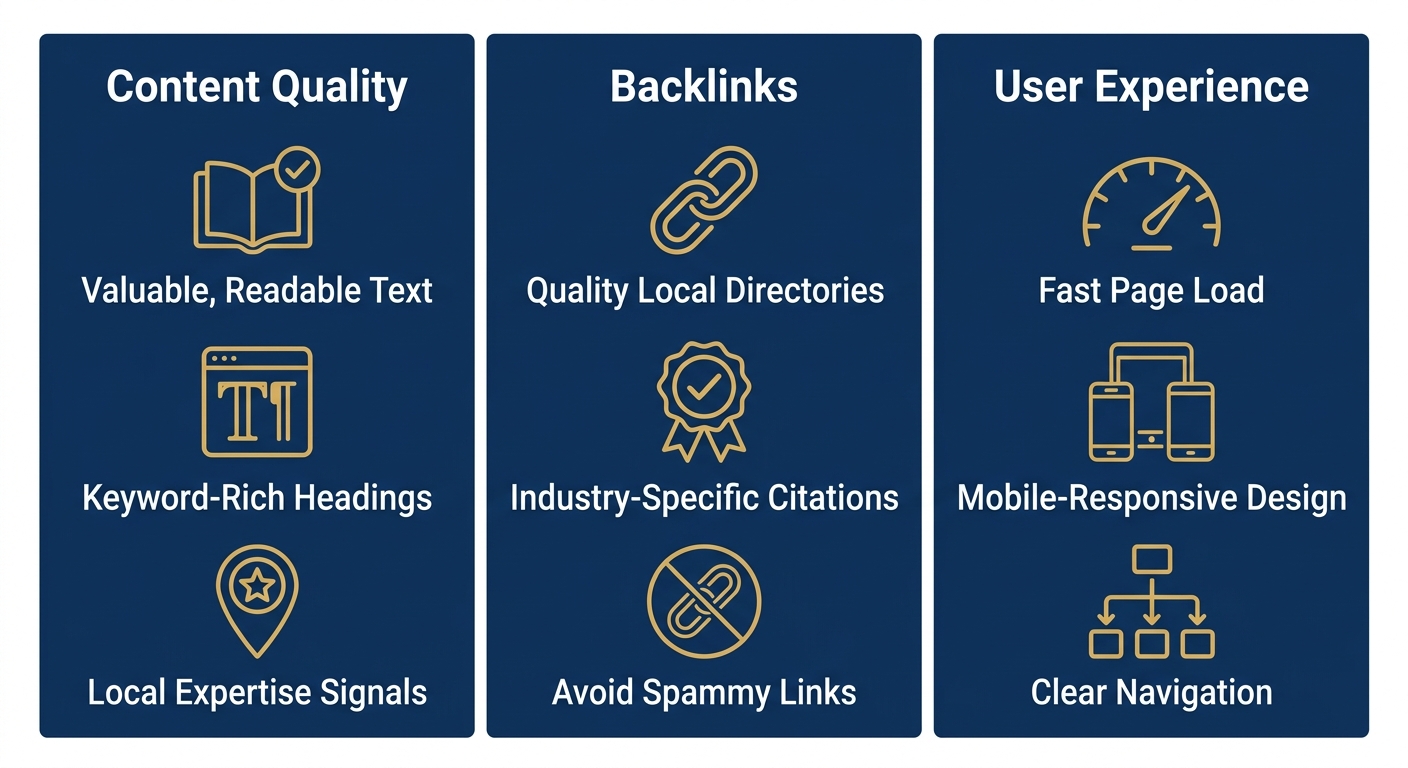
For example, let’s say that the fastest and most well-linked content page does not address the questions local residents have, or the page loads too slowly on mobile devices. In both cases, the ranking potential is undercut by user experience.
Now that we have a strong grasp on these fundamentals, we can dive into the more technical aspects of local SEO.
Deep Dive: Technical On-Page Optimization for Local SEO Content
We aim, for every client project, to first ensure the underlying on-page elements are configured to satisfy both user expectations and algorithmic requirements.
On-Page SEO Components That Drive Local Rankings
We include the primary service terms in title tags, and include a city or region name and the business name if space allows. We write meta descriptions as concise value propositions that mention a location, a core service, and a reason to click. H1 tags are reserved for main topic titles, and H2 and H3 tags are used for subtopic titles for sections. Every image on a local service page receives descriptive alt text that includes a service term and, where appropriate, a location reference, reinforcing local relevance without keyword stuffing.
Technical SEO Foundations Every Local Site Needs
Page speed and mobile-friendliness are critical ranking considerations for local queries, where users frequently search on smartphones. Our audit tools scan for render-blocking resources, oversized images, and inefficient code, then apply fixes that measurably improve load times. We also evaluate responsive design and touch-target sizing to ensure pages perform well on smaller screens, which supports better engagement and discoverability in local results. We implement LocalBusiness schema across client sites to help search engines understand a business’s name, address, phone number, hours, and review information, improving the chances of accurate knowledge panels and rich results. Every site we optimize runs on HTTPS by default, because security influences user confidence and supports stable indexing.
Structuring Local Content for Maximum Search Visibility
For each location or service page, we include an H1 to identify the main topic of the page. We then use H2 to title major blocks of content. This includes service details, coverage area, and FAQs. If there are further subdivisions within those blocks, we use H3 to title them. To avoid repetition, we place the main topic of the page in the H1. We work related phrases into the H2s. Long-tail phrases get worked into the content and body paragraphs.
The following table illustrates how artificial intelligence (AI) driven copywriting compares to manual copywriting and how they impact local SEO.
| Aspect | AI-Driven Copywriting | Traditional Manual Copywriting |
|---|---|---|
| Speed | Generates a complete location page draft in minutes, enabling rapid campaign launches. | Requires hours or days per page due to research, drafting, and editing cycles. |
| Consistency | Applies uniform keyword density, header structures, and tone across dozens of location pages automatically. | Varies by writer workload and skill, often leading to uneven quality across a multi-location site. |
| Keyword Optimization | Analyzes search data to blend primary and secondary keywords at appropriate frequencies without overuse. | Depends on writer expertise; keyword placement may be inconsistent or rely on guesswork. |
| Scalability | Produces hundreds of unique, localized pages simultaneously while preserving individual page quality. | Scaling to dozens of locations demands large writing teams and extended timelines. |
In one hypothetical scenario, a multi-location service provider restructured twenty location pages by aligning H1-H3 hierarchy, refining title tags with geographic terms, and adding LocalBusiness schema. Prior to the changes, the pages attracted roughly 1,200 combined organic visits per month and appeared in the local pack for only four of the twenty cities. After the updates, combined organic traffic rose to approximately 2,200 visits, and local pack visibility expanded to fourteen cities—representing a notable increase in targeted exposure.
Practical: Implementing Your AI-Driven Local SEO Copywriting Workflow
After setting the technical foundations for local SEO, the next logical step is to implement an efficient content creation workflow. A structured approach to AI-powered local copywriting allows businesses to produce location-specific pages and blog posts that align with search intent without overwhelming internal resources.
Creating High-Impact Local Content with AI Copywriting
We begin by crafting a clear prompt that names the target city, service category, and customer intent—for example: “Write a 500-word service page about emergency plumbing in Miami, FL, addressing burst pipes and weekend availability with a helpful, reassuring tone.” That level of specificity guides the draft toward usable local language and relevant subtopics.
When the AI returns a structured draft, we adjust tone settings to match the brand voice and verify natural location phrasing such as “in Miami.” Human editors check factual accuracy, add real customer pain points, and replace generic language with neighborhood details so the page reads like local expertise rather than a template. We then finalize headings, meta snippets, and internal links before publishing. Takeaway: use precise prompts, quick editorial passes, and a weekly batch session to maintain a steady publishing cadence.
Below is a brief comparison of three common production pathways to help you choose based on time and in-house skill.
Comparing Your Content Production Options
Below is a brief comparison of three common production pathways to help you choose based on time and in-house skill.
| Content Production Method | Time Investment | Expertise Required | Typical Results for Local SEO |
|---|---|---|---|
| AI-powered platform like SEOLocal | 1–2 hours per page including editing | Basic keyword selection and brand tone | Fast publication; needs editorial oversight |
| Specialized SEO content writing service | 1–3 weeks turnaround, plus revisions | Little hands-on writing required; good briefing helps | Polished copy; dependent on provider availability |
| Fully DIY approach | 4–8 hours per page for a non-writer | Strong on-page SEO and writing skills | Variable quality; sustained effort required |
Mastering the 80/20 Rule to Multiply Your SEO Results
A small share of pages typically drives most local traffic. We start by auditing existing pages—spotting those that already rank on page two or three for valuable localized terms—and treat them as high-leverage opportunities. For these pages we perform AI-assisted rewrites: expand thin sections, add semantically related subtopics the draft missed, and reinforce internal links from topical blog posts.
The 80/20 lens guides new content priorities: create articles that complement an existing topical cluster instead of scattering one-offs. Make this a quarterly habit—re-audit rankings, reallocate effort, and refresh pages that show traction. Takeaway: focus resources where small improvements yield outsized visibility gains.
Building Your Local Link & GBP Strategy Around Your Content
Every service page or blog post becomes more powerful when it feeds into your broader local presence. We immediately connect new content to a link-building plan by adding contextual internal links from pages with topical authority, signaling the new asset’s relevance.
When available, we push GBP posts across applicable storefronts for multi-location brands and integrate booking links via partners such as Square Appointments or Fresha so organic visits can convert to measurable leads. Takeaway: make content creation and GBP/link updates part of a single, repeatable publishing workflow.
This practical workflow lays the groundwork for scaling your local SEO content through data-driven analytics and automation.
Advanced: Scaling Local SEO Content with Analytics and Automation
Once you have a working content workflow, the next step is to scale it across multiple locations using data and automation. We at SEOLocal built our AI-driven local SEO platform to solve this scaling challenge, moving businesses from basic monthly check-ins to real-time, data-informed content operations.
Effective scaling begins with analytics. Key metrics such as keyword rankings, organic traffic by location, and conversion rates reveal which pages are performing and which need attention. A centralized dashboard that pulls data from Google Search Console and Google Analytics lets you monitor performance across every location simultaneously, turning raw numbers into actionable priorities.
The table below contrasts a basic local SEO setup with an advanced, analytics-backed approach using our AI-driven platform.
| Feature | Basic Local SEO Setup | Advanced AI-Driven SEOLocal Approach |
|---|---|---|
| Reporting Frequency | Manual monthly reports | Real-time dashboards |
| Integration with Google Tools | Limited or no GSC/GA connection | Deep integration with Google Search Console and Analytics |
| Scalability for Agencies | Per-location manual adjustments | AI-powered bulk content creation across unlimited locations |
| Content Production Method | One-off outsourced or in-house writing | AI-driven templates and bulk scheduling for optimized blog content |
| Keyword Tracking | Spreadsheet-based, often delayed | Automated keyword tracking that updates rankings across tracked terms and locations |
| Performance Analysis | Periodic spot-checks on a few metrics | Automated analysis surfacing traffic trends and conversion signals |
With automated reporting and AI-assisted content generation, teams can follow a repeatable workflow: collect performance data, prioritize locations with the highest opportunity, generate location-specific optimized blog content using AI.
AI-driven local SEO can deliver visible ranking movements within 30 days while keeping content quality consistent across every location page. Agencies and multi-location brands gain the ability to manage hundreds of campaigns without linearly growing headcount—a decisive advantage over the basic, manual alternatives.
This advanced approach naturally raises questions about implementation, timelines, and tool selection—which we address next.
Frequently Asked Questions About SEO Copywriting and Local Visibility
Automation has not fully replaced copywriting. Many businesses are still interested in understanding how copywriting relates to local search.
How does SEO copywriting affect local search visibility?
For search engines, the task is to evaluate whether a webpage’s content matches a searcher’s location and intent. When copy naturally incorporates place-specific details—such as neighborhood landmarks or service areas—engines can more confidently serve that page for queries in Miami, FL or similar markets.
What are the best practices for writing blog content that ranks for local queries?
Write individualized content pieces for each topic that your audience is searching for. For each content piece, include locale-specific examples and references. Give practical tips and suggestions where applicable.
Is there a specific structure or format that works best for local SEO blog content?
Scannable formats perform well.
These answers reflect core principles every business can apply.
Taking Your Local SEO Content to the Next Level
We’ve covered keyword research, on-page optimization, and Google Business Profile alignment. Use our AI platform to automate long-form content and GBP updates; start with a 30-day free trial and no-contract. We do not sell or rent client data; the plugin requires consent to create an admin account and to connect to a master server; terms limit liability under Florida law; reply STOP to opt out of SMS messages (message & data rates may apply). Get started. Let us produce seo copywriting and blog content that ranks.
Start Your Content Ranking Journey
You’ve explored the fundamentals of SEO copywriting and blog content that ranks, from keyword strategy to technical on-page optimization. The guide has shown how AI-driven tools can transform your local content workflow, making it more efficient and scalable. Now, you have a clear blueprint to attract targeted local traffic and build credibility. To accelerate your results, Our professional services combine expert content creation with powerful automation. You can test these strategies risk-free with a 30-day trial, without any long-term contract. Take the next step in your local content journey and see what professional SEO support can achieve for your business.