

Blog
Web Design Trends 2026: Ultimate Innovation Guide


Table of Contents
- Web Design Trends 2026: Shaping the Future of Digital Experiences
- The Cornerstones of Web Design in 2026
- AI-Powered Design and the Rise of Immersive Experiences
- Implementing Web Design Trends for 2026: A Practical Guide
- Advanced Techniques: 3D Immersion and AI Automation
- Frequently Asked Questions About Web Design Trends 2026
- Embrace the Future: Elevate Your Online Presence with 2026 Design Trends
Web Design Trends 2026: Shaping the Future of Digital Experiences
Looking ahead, the web design trends 2026 is set to introduce represent a decisive shift toward more interactive, intelligent, and personalized digital experiences. We see immersive 3D environments, AI-powered creation tools, and ever-more-sophisticated responsive frameworks converging to redefine how users interact with brands online. This evolution is moving beyond static pages, creating dynamic destinations that anticipate and adapt to individual user needs. Our team is actively tracking these developments, ensuring we implement forward-looking strategies that keep our partners at the forefront of their industries.
Among the most transformative developments, ai-powered web design is revolutionizing how we approach layout generation, content optimization, and real-time personalization. Simultaneously, immersive 3d web design is creating captivating digital spaces, such as interactive product configurators and virtual showrooms, that offer unprecedented levels of user engagement. We anticipate these tools will allow businesses to tell their stories in more compelling and memorable ways. At the same time, a foundational principle continues to be critical; as our FAQ on responsive design illustrates, responsive web design remains the bedrock of any effective digital strategy, now evolving with fluid grids, adaptive images, and CSS media queries to ensure flawless performance across every new device and screen size.
The future of web design is about creating seamless, adaptive ecosystems that put the user experience first. By integrating AI-driven local SEO techniques with these new visual and structural standards, businesses can build powerful platforms ready for the innovations of 2026 and beyond.
The Cornerstones of Web Design in 2026
In 2026, web design trends 2026 build on a foundation of fluid adaptability and intelligent user experiences. One of the most enduring cornerstones is responsive web design, which has evolved from simple fluid grids into container-query-driven layouts that morph seamlessly across devices. As we examine the priorities shaping modern sites, we see a clear shift from static, desktop-first thinking to AI-powered personalization and immersive interaction.
The table below contrasts traditional design principles with the emerging priorities that define the web in 2026.
| Aspect | Traditional (Pre-2025) | 2026 Trends |
|---|---|---|
| Layout and Grid | Fixed-width, rigid grids | Fluid, responsive, and container-query-based |
| Aesthetics | Flat design, heavy use of images | Glassmorphism, neo-brutalism, and 3D elements |
| Performance Priority | Page load speed (desktop-first) | Core Web Vitals and mobile-first indices |
| User Interaction | Click and scroll | Voice, gesture, and 3D navigation |
| Content Creation | Manual writing and stock photography | AI copywriting and dynamic content personalization |
Each shift reflects a broader move toward adaptability and intelligence. Layout and Grid have moved beyond fixed-width designs to fluid systems powered by container queries. Aesthetics have abandoned flat design in favor of glassmorphism, neo-brutalism, and richly layered 3D visuals. Performance Priority centers on Core Web Vitals and mobile-first indexing as baselines. User Interaction has expanded from simple clicks to voice commands, gesture controls, and 3D spatial navigation. Content Creation now relies on AI copywriting and generative models that personalize every element to match user intent.
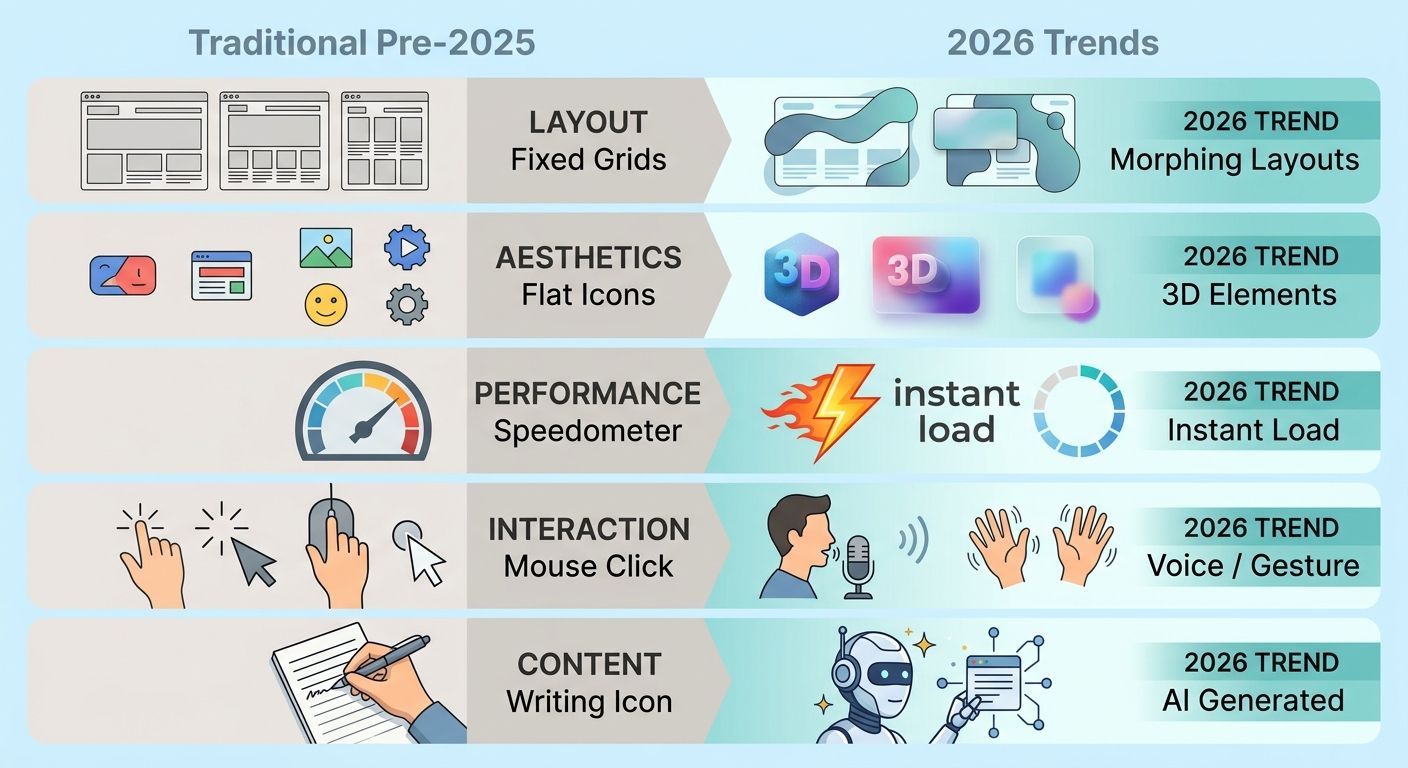
Web design evolution from pre-2025 principles to 2026 trends
AI-Powered Design and the Rise of Immersive Experiences
Artificial Intelligence in Web Design
AI-powered web design tools are transforming how websites are built. Platforms like Wix ADI generate complete sites from a short questionnaire, while Adobe Sensei provides asset and layout suggestions that accelerate creative workflows. Beyond layout generation, AI now extends to SEO—for instance, SEOLocal offers affordable SEO services in Deland that use AI to accelerate local rankings. The following table compares leading AI-powered design platforms based on automation, customization, and pricing:
| Platform | Automation Level | Customisation | SEO Features | Pricing (Monthly) |
|---|---|---|---|---|
| Wix ADI | Full site generation | Medium | Basic SEO wizard | From $16 |
| Adobe Sensei | Asset assistance | High | Integrated suite | Part of CC ($55+) |
| Hostinger AI Builder | Prompt-to-site | Medium | Smart suggestions | From $3 |
| 10Web AI | WordPress rebuilds | Medium | Advanced audit | From $14 |
Immersive 3D and Interactive Elements
Immersive 3d web design relies on technologies such as WebGL, Three.js, and CSS 3D transforms to create interactive product showcases and rich storytelling without heavy plugins. Brands across industries now build product configurators that let customers explore items from every angle. These experiences boost engagement, increase time on page, and can raise conversion rates by turning passive browsing into active exploration. Designers can also layer subtle interactive touches, like parallax scrolling or animated data visualizations, that guide attention and deepen brand connection.
The Role of Minimalism in Modern Interfaces
Minimalism remains a powerful design philosophy because it reduces cognitive load, improves load times, and focuses user attention. Clean layouts with generous whitespace, crisp typography, and restrained color palettes create a sense of calm. When paired with AI, minimalism becomes even more effective: AI can personalize the interface for each visitor while maintaining a clean, uncluttered look. Faster load times not only improve user satisfaction but also contribute to better search engine rankings—a critical factor for local businesses.
Implementing Web Design Trends for 2026: A Practical Guide
Steps to Adopt AI-Driven Design for Your Business
Integrating ai-powered web design into your workflow doesn’t require a complete overhaul overnight. We recommend a 5-step process: First, audit your current site. Second, define objectives for AI tools. Third, choose a suitable AI platform. Fourth, run a prototype on a staging environment. Finally, measure performance. This phased approach ensures that adopting cutting-edge trends doesn’t compromise your site’s stability.
Small Business Success: Leveraging Minimalism and Speed
For small businesses, minimalist web design is a direct path to cutting costs and improving user experience. By stripping away excessive code, your site becomes faster and easier to maintain. Fast-loading one-page sites are exceptionally effective for local service businesses. A lean site that loads in under two seconds can dramatically reduce bounce rates and improve conversion rates compared to feature-heavy competitors using unoptimized 3D elements.
Integrating SEO with Modern Web Design
Modern web design and search engine optimization must be woven together. According to SEO and PPC marketing news, semantic HTML5 elements provide essential context to search crawlers. Using tags like <article> and <nav> correctly structures content for both accessibility and algorithm comprehension. A mobile-first responsive design is non-negotiable, as it aligns with Google’s mobile-first indexing.
Advanced Techniques: 3D Immersion and AI Automation
| Technology | Performance | Learning Curve | SEO Compatibility | Best For |
|---|---|---|---|---|
| Three.js / WebGL | High | Steep | Low | Product configurators |
| CSS 3D Transforms | Medium | Moderate | High | Minimal 3D effects |
| Spline | Optimised | Medium | Low | Design prototypes |
Frequently Asked Questions About Web Design Trends 2026
What are the top web design trends for 2026? The most impactful web design trends 2026 include responsive design, immersive 3D elements, and AI-powered web design tools.
How can I make my website responsive for 2026 trends? We recommend a mobile-first approach using fluid grids and flexible images.
What is immersive 3D web design? Immersive 3D web design incorporates three-dimensional visuals and interactive environments to captivate users.
Embrace the Future: Elevate Your Online Presence with 2026 Design Trends
The web design trends 2026 emphasize immersive 3D web design, AI-powered personalization, and mobile-first minimalism. These interactive experiences keep visitors engaged. AI-powered web design automates content adaptation for personalized journeys. Our AI-driven platform embodies this shift, helping businesses build adaptive websites that captivate and convert.